
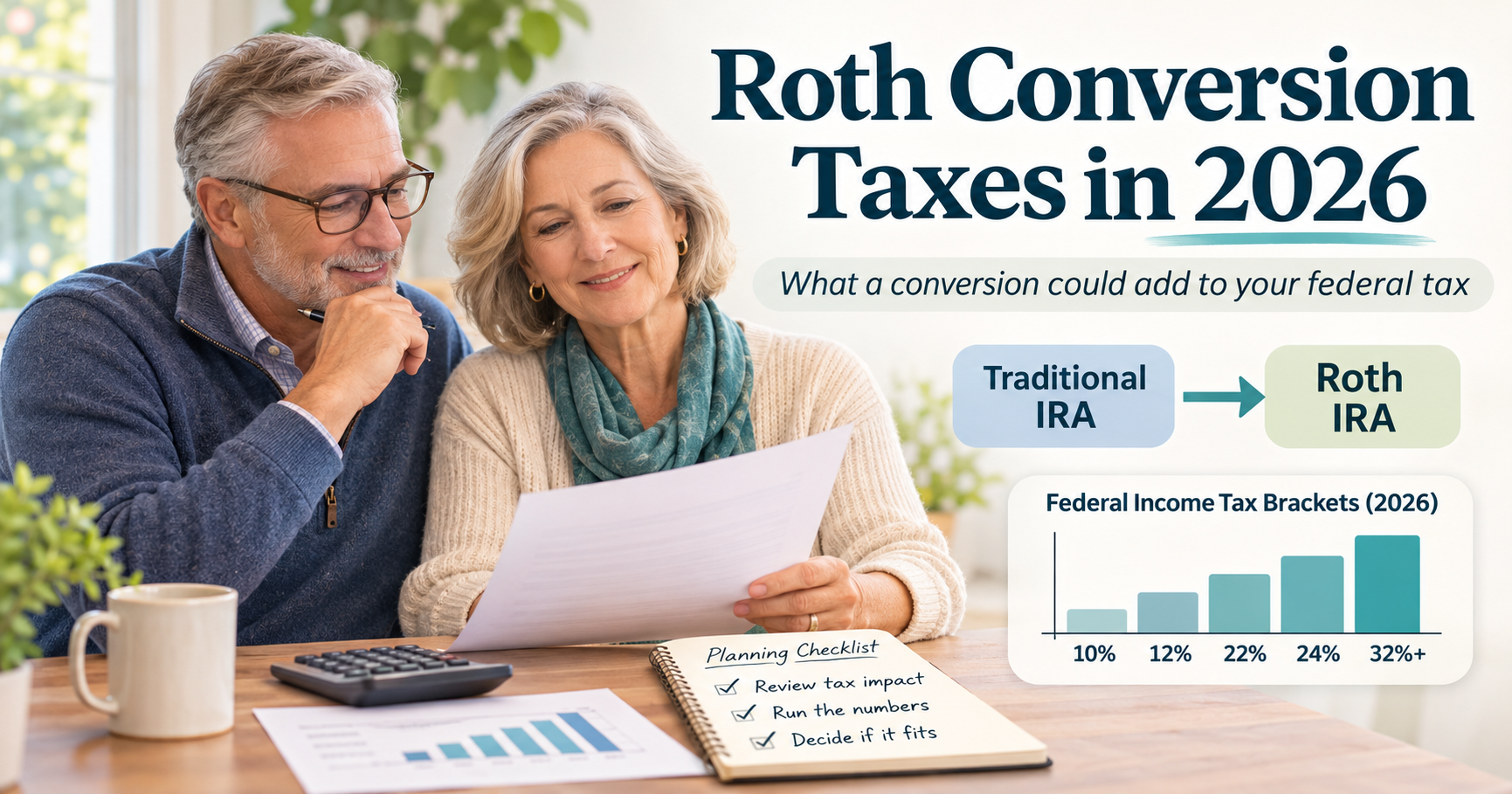
Roth conversion taxes in 2026 generally depend on how much of the conversion adds to your ordinary income for the year. The incremental federal tax depends on filing status, other taxable income, any IRA basis from nondeductible contributions, and the brackets crossed. State taxes and income-related costs may also matter.
The essential planning question is not just what the conversion costs today, but what paying that tax is intended to accomplish for retirement later.
How much tax will I pay on a $50,000 Roth IRA conversion?
A $50,000 conversion does not have one fixed tax cost. If its entire taxable amount falls in the 22% federal bracket, it produces approximately $11,000 in additional regular federal income tax, ignoring interactions with credits, deductions and other taxes. If part enters a higher bracket, the incremental tax increases. Compare estimated federal taxes with and without the conversion, rather than applying one rate automatically.
Hypothetical example 1: A $50,000 conversion
A married couple filing jointly has $150,000 in taxable income before conversion and converts $50,000 of entirely pretax traditional IRA money. Assuming no other changes, taxable income rises to $200,000. Because the 2026 joint-filer 22% bracket extends from over $100,800 to $211,400, the full conversion falls in that bracket. Additional regular federal income tax: $50,000 × 22% = $11,000. This excludes state taxes and other tax interactions.
Would paying an additional $11,000 in federal tax now support a specific later retirement goal?
What is the income bracket for converting Roth IRAs to a 22% tax rate?
A Roth conversion has no special 22% conversion rate. The taxable part generally follows the ordinary income tax brackets, which apply to taxable income—not gross salary or total account value.
| 2026 filing status | 22% bracket begins above | 22% bracket ends at |
| Single | $50,400 | $105,700 |
| Married filing jointly | $100,800 | $211,400 |
| Head of household | $67,450 | $105,700 |
| Married filing separately | $50,400 | $105,700 |
A conversion can fall partly in one marginal bracket and partly in another. Crossing into the 24% bracket does not mean all your income becomes taxed at 24%. Source: IRS Revenue Procedure 2025-32 (2026 tax tables).
If you converted only enough to reach the top of your current bracket, how much would that leave for a later year?
How am I taxed on a Roth conversion?
The taxable portion of a Roth conversion generally increases ordinary income for the calendar year of the conversion. The actual additional tax is calculated using the full tax return, including filing status, deductions, other income, applicable credits and any nondeductible IRA basis. For an accurate estimate, compare the full return with and without the proposed conversion; a conversion does not carry its own flat tax rate.
How are Roth conversions taxed in 2026?
When pretax traditional IRA funds are converted into a Roth IRA, the previously untaxed portion generally becomes ordinary taxable income in the conversion year. Nondeductible traditional IRA contributions can create tax basis, meaning some conversion dollars may be nontaxable. The IRS aggregation and pro-rata calculations generally consider traditional, SEP, and SIMPLE IRA balances where applicable, rather than treating a selected nondeductible deposit as isolated. Form 8606 is used to report relevant basis and conversion calculations.
What would your estimate look like if your records showed nondeductible IRA contributions?
At what tax bracket do Roth conversions make sense?
There is no single tax bracket that makes a Roth conversion worthwhile for everyone. The question is whether paying tax at your projected current marginal rate makes sense compared with plausible future rates and other costs. Test several conversion amounts, not just the amount that fills a bracket, and consider available cash, Medicare premiums and state taxes.
What is the best Roth conversion strategy?
A defensible strategy starts with a multi-year comparison rather than a universal conversion amount. Estimate taxable income and IRA basis, model partial conversions over several years, and examine future income needs, beneficiaries, tax-payment cash and relevant Medicare or state-tax effects. The best approach depends on the household and should be reviewed with a qualified tax professional.
What is the sweet spot for Roth conversion?
No universal sweet spot exists. Some households evaluate relatively low-income years, intervals between retirement and other income streams, or the remaining room in a selected marginal bracket. A tax-bracket approach alone is incomplete: Social Security taxation, Medicare’s income-related monthly adjustment amount (IRMAA), state tax, access to outside funds to pay the tax, cash reserves, future tax expectations, and withdrawal horizon also deserve review.
Hypothetical example 2: Two conversion amounts
A single filer has $90,000 of taxable income before conversion in 2026. Assume every converted dollar is taxable and other tax facts do not change. A $15,000 conversion stays in the 22% bracket and produces about $3,300 of additional regular federal income tax. A $30,000 conversion uses $15,700 in the 22% bracket ($3,454), with the remaining $14,300 taxed at 24% ($3,432). Total additional federal tax: $6,886. The calculation is intentionally limited to regular federal tax; the examples are not personal projections.
| Hypothetical option | Taxable conversion | Additional regular federal tax |
| No conversion | $0 | $0 |
| Convert $15,000 | $15,000 | $3,300 |
| Convert $30,000 | $30,000 | $6,886 |
Infographic 1 — How a Roth conversion taxes in 2026 crosses two tax brackets
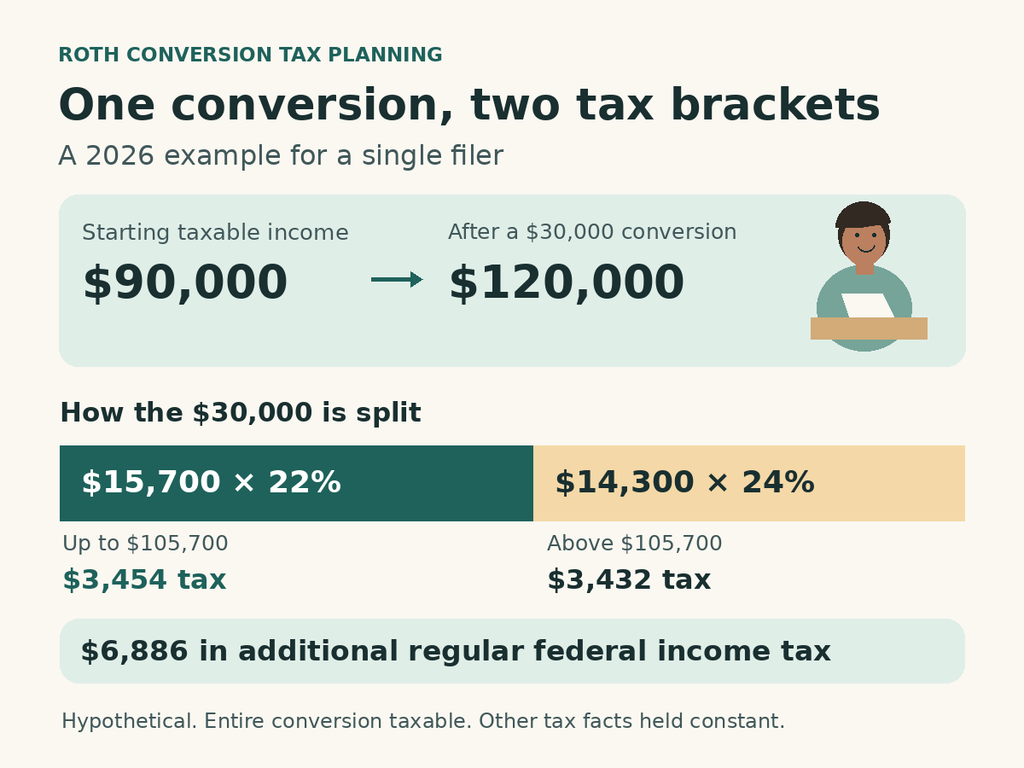
In this hypothetical 2026 single-filer example, $105,700 is the boundary between the two brackets.
What if a series of smaller conversions across multiple years gave you more control over the annual tax consequences? A tax projection can test that assumption.
To compare conversion amounts, estimate full-year taxable income, establish IRA basis, model the tax with and without each conversion, and check cash available to pay taxes. Review state tax, Medicare premiums and withdrawal timing.
Infographic 2 — Before you choose a conversion amount
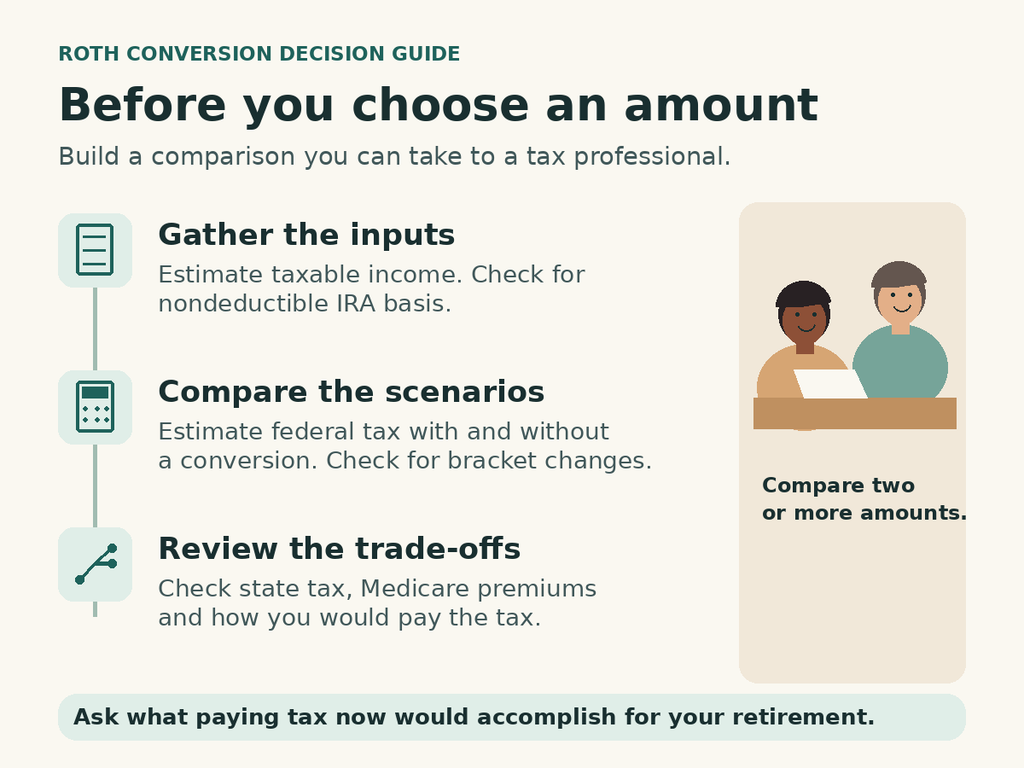
Gather your inputs, compare conversion amounts and review the wider costs before making a decision.
What is the downside of converting IRA to Roth?
The immediate income-tax obligation may be substantial. The conversion can influence Medicare income-related premium adjustments in later years, the taxable share of Social Security benefits, certain income-sensitive deductions or credits, and state income tax. Paying the tax may consume liquidity that would otherwise be invested or held in reserve. Conversions from 2018 onward generally cannot be recharacterized back to a traditional IRA.
What are the potential downsides of a Roth IRA conversion?
Beyond the initial income-tax cost, a conversion can affect income-sensitive calculations, including certain Medicare premiums and the taxable portion of Social Security benefits. It can also reduce liquid reserves when tax is paid from outside assets or trigger additional consequences if funds are withheld or distributed. These trade-offs should be compared with potential long-term benefits, not evaluated in isolation.
What are 11 mistakes to avoid with a Roth IRA?
The following eleven examples focus specifically on Roth conversion decisions, not every possible Roth IRA rule. They include tax-estimation errors, missed IRA basis, withdrawal-rule misunderstandings and overlooked downstream effects. Review each item against your own facts before completing a conversion.
- Confusing gross income with taxable income.
- Assuming all converted dollars are taxed at a single bracket rate.
- Missing documented nondeductible IRA basis on Form 8606.
- Ignoring other traditional, SEP or SIMPLE IRA balances when basis is calculated.
- Failing to model state income-tax treatment.
- Using retirement assets for withholding without evaluating distribution consequences.
- Overlooking possible Medicare IRMAA increases.
- Ignoring effects on the taxable portion of Social Security.
- Assuming an otherwise completed conversion can be undone.
- Confusing the different Roth IRA five-year requirements.
- Failing to evaluate estimated-tax or withholding obligations.
What are common mistakes to avoid with Roth IRA conversions in 2026?
The most common conversion errors are estimating tax from gross income rather than taxable income, ignoring nondeductible IRA basis and other IRA balances, and overlooking secondary costs such as Medicare premiums or state taxes. The eleven-point checklist immediately above provides a broader pre-conversion review.
Do I have to wait 5 years after each Roth conversion?
Different five-tax-year rules apply to Roth IRAs. For earnings to be part of a qualified distribution, a Roth IRA generally must satisfy its overall five-tax-year qualification period plus a qualifying condition such as age 59½. A separate five-tax-year period for each conversion can affect the 10% early-distribution additional tax on taxable converted amounts when withdrawn early. Someone age 59½ or older generally is not subject to that additional tax solely because converted principal is withdrawn within five years, but earnings qualification and distribution ordering still require attention. Consult IRS Publication 590-B for the detailed rules.
A final question before converting
If I pay taxes on this money today, what specific future benefit am I trying to achieve? A comparison of potential future outcomes is more useful than an automatic yes or no.
Continue learning with AltaVida Capital
If you are deciding when to convert, read Roth Conversion 2026 Taxes and Timing for year-end timing and processing considerations. For a projection based on your own return, consult a qualified tax professional.
Educational disclosure
This article provides general education and hypothetical illustrations. Consult a qualified professional for individualized tax, legal, investment or insurance advice.
Official sources checked November 5 2026
- IRS Revenue Procedure 2025-32 / Internal Revenue Bulletin 2025-45 — https://www.irs.gov/irb/2025-45_IRB
- IRS Publication 590-A — https://www.irs.gov/publications/p590a
- IRS Publication 590-B — https://www.irs.gov/publications/p590b
- IRS Form 8606 — https://www.irs.gov/forms-pubs/about-form-8606
- IRS Publication 505 — https://www.irs.gov/publications/p505
- SSA Medicare premiums — https://www.ssa.gov/benefits/medicare/medicare-premiums.html
IRS Publication 915 — https://www.irs.gov/publications/p915