Should You Convert Your Traditional IRA to a Roth Before December 31, 2026?
Roth conversion 2026 planning deserves careful attention before December 31. Moving eligible traditional IRA funds into a Roth IRA may provide future tax advantages, but converting creates an immediate tax consideration. Understanding the timing, potential costs, and long-term consequences is essential before making a decision.
Roth Conversion 2026: Why Year-End Timing Matters
A Roth conversion could change how your retirement savings are taxed. But converting before year-end is not automatically the right decision for everyone.
If you have money in a traditional IRA, you may be considering moving some or all of it into a Roth IRA before December 31, 2026.
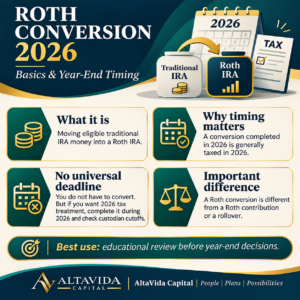
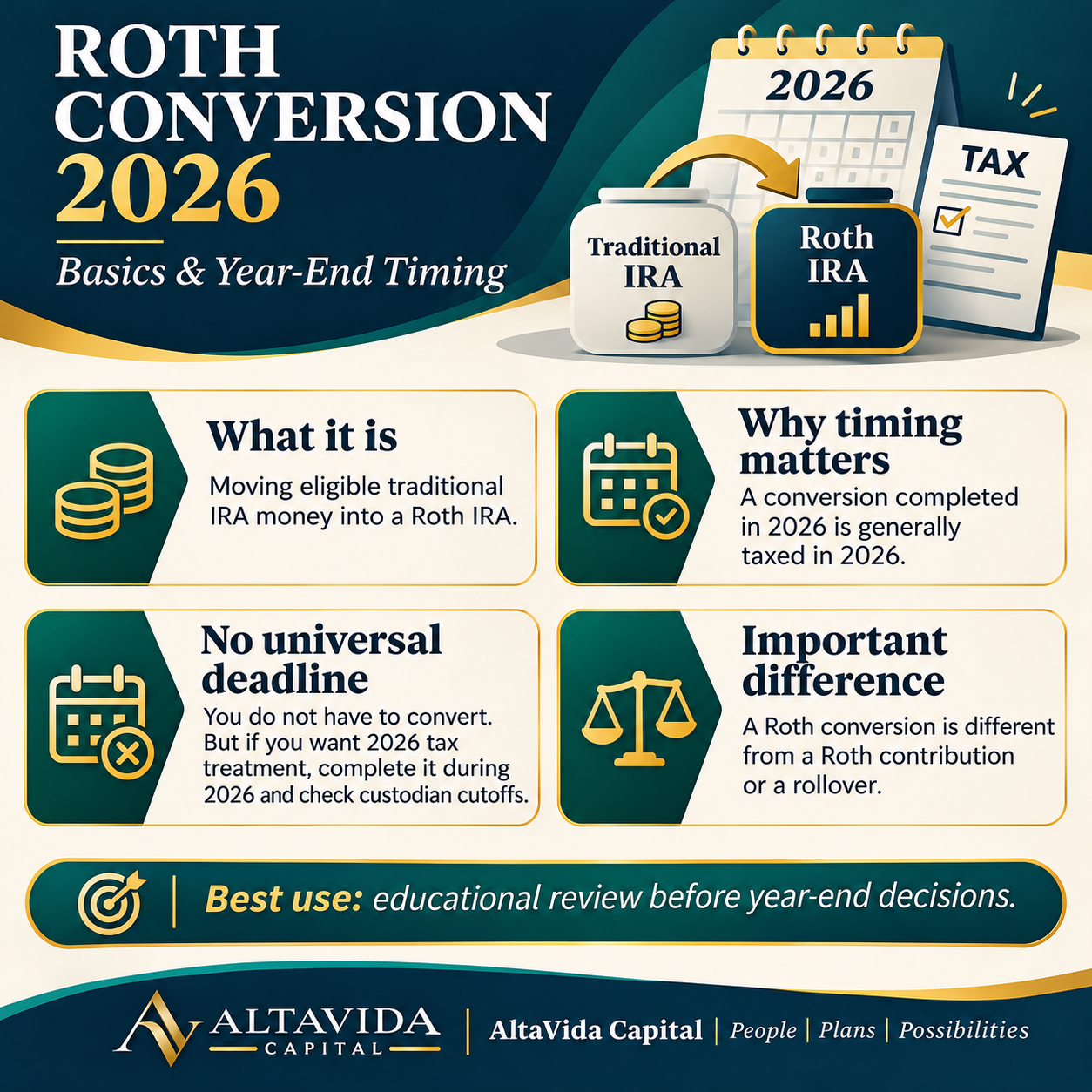
Why does the date matter? A Roth conversion generally creates taxable income in the calendar year the conversion occurs. Completing a conversion in 2026 means evaluating that transaction under your 2026 tax circumstances.
The decision deserves careful consideration, particularly if you’re approaching retirement, receiving pension income, or expecting a change in your future tax bracket.
1. Do you have to do a Roth conversion before December 31?
No. There is no general IRS requirement to convert your traditional IRA into a Roth IRA.
However, if you want a conversion treated as occurring in the 2026 tax year, it generally must be completed by December 31, 2026.
Financial institutions may establish earlier processing deadlines. Contact your IRA custodian well before year-end.
Unlike regular IRA contributions, Roth conversions cannot generally be designated for the previous tax year simply by completing them before the April tax-filing deadline.
2. Is 2026 a good year to convert to a Roth IRA?
Possibly, depending on your circumstances.
A conversion may deserve consideration if:
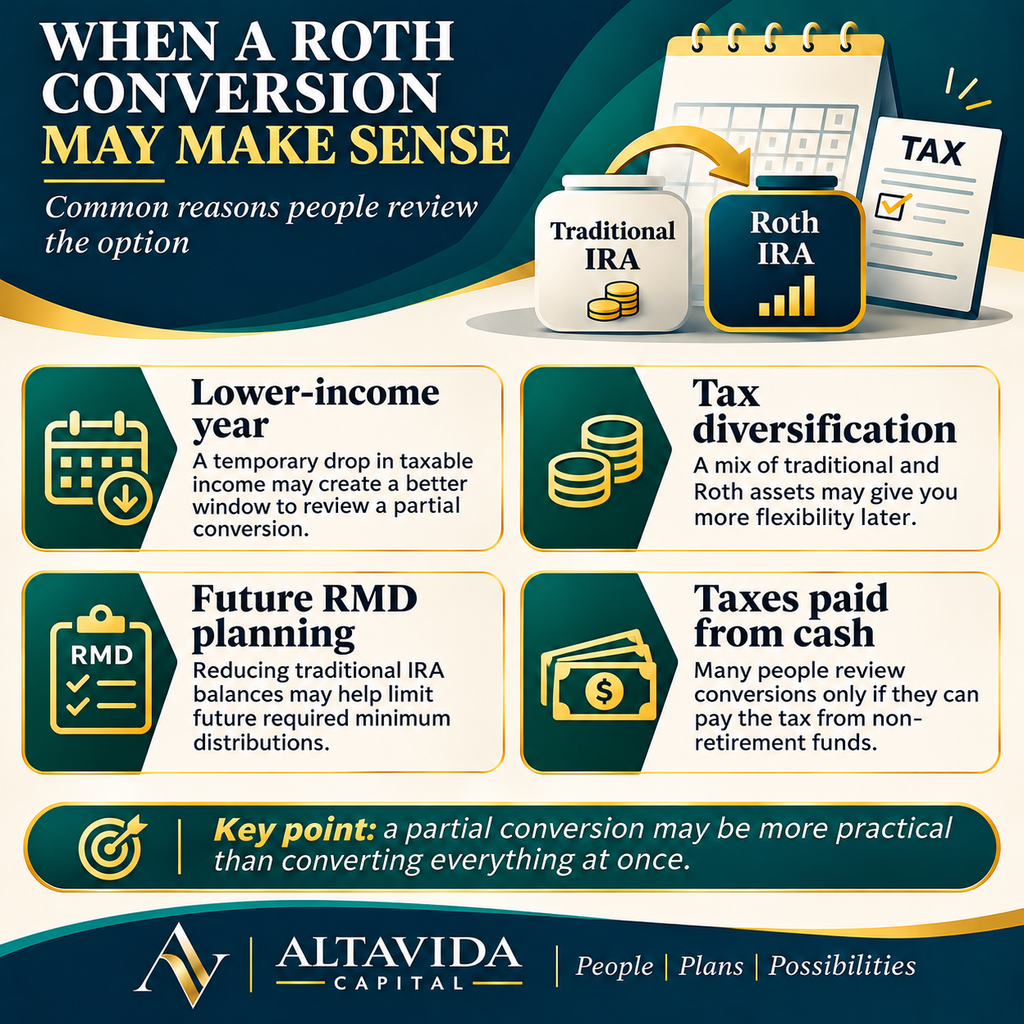
- Your taxable income is temporarily lower than usual.
- You expect a higher marginal tax rate in retirement.
- You have enough money outside the IRA to pay the conversion taxes.
- You want to reduce future traditional IRA balances and potentially reduce future required minimum distributions.
- You want to diversify the tax treatment of your retirement assets.
There is no universal answer. A year that is favorable for one household may be costly for another.
3. What is the best time to convert a traditional IRA to a Roth IRA?
The appropriate time depends on income, expected future tax rates, available cash, and retirement plans.
For example, someone who retires midway through the year may experience a temporary reduction in wages. That could create an opportunity to evaluate a partial conversion before pension income or required minimum distributions increase taxable income.
The right analysis considers total taxable income, not just the traditional IRA balance.
4. What is the best month to do a Roth conversion?
There is no universally favorable month.
Some people prefer late-year conversions because they have a clearer estimate of annual income. Others convert earlier to complete the transaction and avoid administrative delays.
Market conditions can also affect the number of investment shares converted, but future returns and tax outcomes cannot be predicted reliably.
The more important consideration is whether the transaction fits your overall tax and retirement strategy.
5. When should you convert a traditional IRA to a Roth?
Consider reviewing a conversion when your circumstances change.
Examples include retirement, a temporary reduction in income, the sale of a business, changes in pension payments, or the years before required minimum distributions begin.
A partial conversion may allow you to control the amount of additional taxable income recognized in a particular year.
Before converting, estimate your full-year income and deductions and review the federal and applicable state tax consequences.
6. Do Roth conversions go away in 2028?
There is no generally applicable federal rule currently scheduled to eliminate traditional IRA-to-Roth IRA conversions in 2028.
Proposals and predictions about future tax legislation should not be confused with enacted law.
The federal income-tax rates of 10%, 12%, 22%, 24%, 32%, 35%, and 37% were made permanent under legislation enacted in July 2025.
That does not guarantee tax laws will remain unchanged forever. Future legislation could change retirement or tax rules.
7. Is Roth IRA going up in 2026?
This question can refer to contribution limits, taxes, or account values.
Roth IRA contribution limits are subject to IRS rules and inflation adjustments. Roth conversions are different: there is no annual dollar ceiling specifically limiting how much eligible traditional IRA money can be converted.
A large conversion may nevertheless generate substantial taxable income.
Traditional IRAs containing nondeductible contributions require special calculations to determine the taxable portion of a conversion.
8. Do Roth conversions ever make sense?
Yes, in certain circumstances.
A Roth conversion involves paying tax now on amounts that would otherwise generally be taxed when distributed from a traditional IRA.
Qualified Roth IRA distributions can be tax-free, subject to applicable requirements.
A conversion may be attractive when the current tax cost is expected to be lower than the future tax burden being avoided.
However, the analysis must account for more than tax brackets alone.
9. Who benefits most from Roth conversions?
People who may benefit include those experiencing temporarily lower taxable income, individuals expecting higher future tax rates, and households seeking greater tax diversification in retirement.
Someone with substantial traditional retirement savings may also want to examine how future required minimum distributions could affect their income.
The potential benefit depends on the current tax cost, the time horizon, future withdrawal needs, and other financial considerations.
10. At what point is Roth better than traditional?
A Roth account is not automatically superior to a traditional retirement account.
Traditional retirement savings may provide an upfront tax deduction or pre-tax contribution treatment, with distributions generally taxable later.
Roth savings generally use after-tax money, while qualified withdrawals can be tax-free.
The comparison depends heavily on the tax rates paid when money enters or leaves the retirement system.
Other considerations include estate planning, available cash, eligibility rules, and future tax-law changes.
11. When should you avoid a Roth conversion?
A conversion may be disadvantageous when:
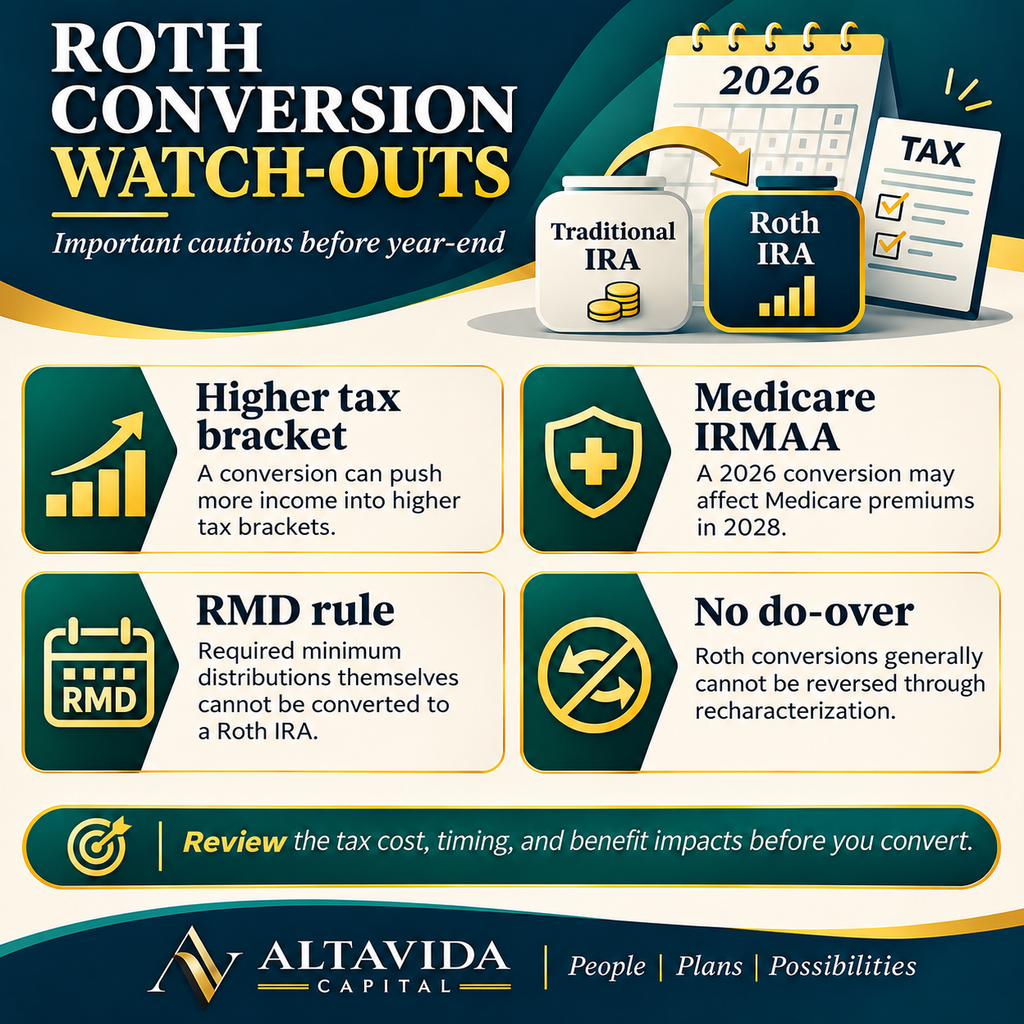
- It pushes significant income into higher marginal tax brackets.
- You expect substantially lower tax rates when withdrawing retirement money.
- You cannot afford the conversion tax without disrupting essential financial reserves.
- It increases Medicare income-related premiums.
- It reduces eligibility for income-sensitive tax benefits.
- It introduces unexpected state income-tax consequences.
People subject to required minimum distributions must also distinguish their RMD from amounts eligible for conversion. An RMD cannot itself be converted to a Roth IRA.
Roth conversions completed after 2017 generally cannot be reversed through re-characterization.
12. Do you have to pay taxes immediately on a Roth conversion?
A taxable Roth conversion generally creates federal income-tax liability for the year of conversion.
That does not necessarily mean the entire tax must be paid on the day of the transfer.
Depending on total income, withholding, and estimated payments, additional tax payments may be necessary to avoid underpayment penalties.
The conversion is generally reported using IRS Form 8606 and relevant tax-return documentation.
For illustration, if an entirely taxable $50,000 conversion fell wholly within a 22% federal marginal bracket, the federal tax attributable to the conversion would be approximately $11,000.
In practice, a conversion can span tax brackets, and the actual additional tax can differ considerably.
A special concern: Medicare premiums
A taxable Roth conversion may increase modified adjusted gross income used in determining Medicare income-related monthly adjustment amounts, known as IRMAA.
Medicare generally uses tax-return information from two years earlier. Consequently, income recognized through a 2026 Roth conversion could influence 2028 Medicare premiums.
This is particularly important for retirees already enrolled in Medicare or approaching eligibility.
Your 2026 Roth Conversion Review Checklist
Before making a conversion decision, confirm:
- Your expected total taxable income for 2026.
- The amount of eligible traditional IRA funds available.
- Whether you have any nondeductible traditional IRA basis.
- Your current marginal federal and state income-tax rates.
- Whether the conversion affects Medicare premiums or other income-based benefits.
- Whether required minimum distributions must be completed first.
- How the conversion taxes will be paid.
- Your custodian’s 2026 transaction deadline.
- Whether a partial conversion would be more appropriate than converting the entire balance.
Questions Worth Asking Before You Convert
A Roth conversion is more than a tax transaction. It is a decision about when to recognize taxable income, how to manage retirement assets, and what financial flexibility you want in the future.
Before deciding whether a Roth conversion in 2026 makes sense, consider these questions:
1. What would make paying taxes on my retirement savings today more advantageous than paying them later?
Consider how your current taxable income compares with the income you expect during retirement.
2. If I convert $50,000 this year, what happens to my total tax liability?
A conversion could push part of your income into a higher marginal tax bracket. The effect depends on your complete tax situation.
3. Could reducing my future traditional IRA balance justify paying conversion taxes now?
Consider future required minimum distributions, retirement income needs, and the potential value of tax diversification.
4. Could a conversion affect more than my income taxes?
Consider Medicare IRMAA, state income taxes, and other income-sensitive benefits or costs.
5. Am I considering a conversion because it supports my retirement objectives—or simply because December 31 is approaching?
A year-end deadline should prompt careful evaluation, not an automatic transaction.
Your Next Step
Write down your answers, identify what you still need to verify, and review the numbers with a qualified tax professional before making a conversion decision.
The objective is not simply to convert. It is to understand whether converting supports your financial circumstances and long-term goals.
Final Perspective
December 31, 2026, is an important tax-year boundary, but it is not a mandatory conversion deadline for everyone.
The central question is not simply whether to convert before year-end. It is whether paying the conversion tax under your 2026 circumstances supports your long-term retirement objectives.
A carefully evaluated partial conversion may be more appropriate than an all-or-nothing decision.
Before acting, coordinate with a qualified tax professional and, where appropriate, an authorized financial professional.
Official sources
- IRS — Retirement Plans FAQs Regarding IRAs
- IRS — Publication 590-A
- IRS — Publication 590-B
- IRS — Roth IRA Contributions
- Medicare — Medicare Costs
AltaVida Capital | People | Plans | Possibilities
Educational information only. This article does not constitute individualized tax, legal, securities, or investment advice. AltaVida Capital is not affiliated with or endorsed by the IRS, Medicare, or another government agency. Tax rules and individual circumstances should be verified before executing a transaction.