

When Should You Start Planning for Military Retirement?
Start planning for military retirement roughly 24–36 months before your expected retirement date, rather than waiting for the final year. The Army’s official retirement process uses that window for initial research, while Military OneSource recommends early transition preparation and identifies mandatory TAP milestones. A military retirement planning timeline gives the entire household time to understand income, healthcare, survivor benefits, work and relocation before deadlines arrive. [1][2]
This guide focuses on regular retirement from active duty. National Guard, Reserve, disability and other retirement paths may have different eligibility and timing requirements; confirm your branch-specific process with the relevant personnel or Retirement Services Office.
Why begin 24–36 months before retirement?
A military retirement planning timeline matters because retirement changes more than a monthly paycheck. Basic pay and allowances end, a different retired-pay system begins, healthcare enrollment can change, and family members may need to coordinate employment, housing and beneficiary decisions. The Army recommends early research on retirement dates, location, savings, retirement-pay estimates, survivor coverage and healthcare. [1][10]
Treat the first phase as discovery, not a commitment to retire on a particular date. A good military retirement planning timeline leaves room to change course when service obligations, household priorities or retirement orders change.
The time bands below are suggested planning phases, not uniform deadlines for every branch, service component or retirement type. Verify mandatory requirements with the appropriate service office.
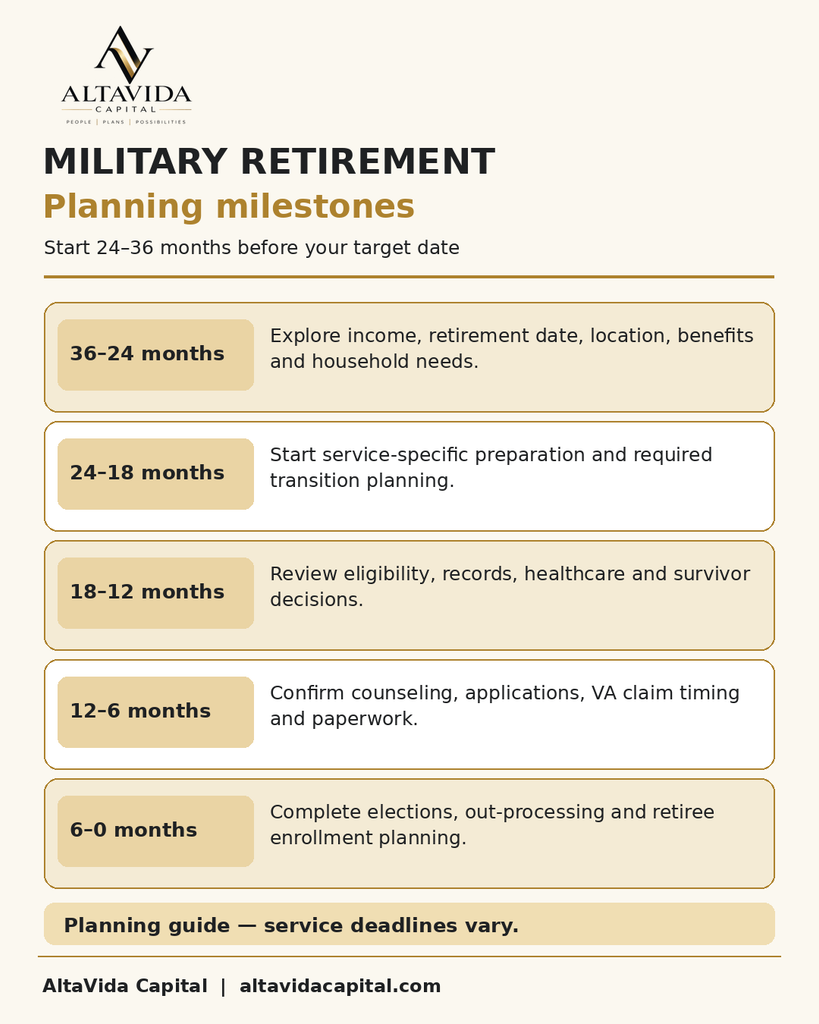
A practical military retirement planning timeline
36–24 months: build the household picture
Begin your military retirement planning timeline by estimating retired pay using the retirement system that actually applies to your service. List what active-duty compensation includes beyond base pay—housing, healthcare and other benefits—and create a rough post-retirement budget. Compare the location you want with your family’s career, school, healthcare and housing needs. Schedule a conversation with the installation retirement services or personnel office. [1][10]
24–18 months: begin transition and employment research
The military retirement planning timeline also includes TAP, which retiring service members should begin early. Military OneSource states that retirement-transition programming can start up to 24 months out, with required individualized initial counseling and pre-separation counseling generally completed at least 365 days before leaving active duty. The TAP process also covers civilian employment, education and VA benefits. [2][3]
18–12 months: test the intended retirement date
At this point in a military retirement planning timeline, check your service-specific application period and required obligations; a preferred date is not automatically an approved date. Review terminal leave, final moves, projected pay, household insurance needs and spouse employment. Confirm your TAP progress and administrative calendar with the appropriate service offices. [1][2]
12–6 months: turn research into decisions
Include Survivor Benefit Plan (SBP) election requirements in your military retirement planning timeline, along with beneficiary records, household insurance, tax withholding and projected cash flow. Keep clear copies of service and medical records. If you are considering VA disability compensation, check eligibility for the Benefits Delivery at Discharge (BDD) program and plan for the 180-to-90-day pre-separation filing window. [4]
Final six months and first 90 days: execute and verify
The final phase of your military retirement planning timeline calls for confirming retirement orders, pay forms and service-specific out-processing requirements. For eligible service members retiring directly from active duty, retirement is a TRICARE qualifying life event. To keep TRICARE Prime or TRICARE Select without a break in coverage, generally reenroll within 90 days after retirement. If that window is missed, eligible retirees may request retroactive Prime or Select enrollment within 12 months of the retirement date, with coverage backdated to retirement and applicable enrollment fees due. This is not an automatic extension of the 90-day deadline. Confirm eligibility, update DEERS and identification cards, and verify coverage for each family member. [5]
DFAS generally pays military retired pay monthly on the first day of the month; a weekend or holiday can shift the retiree payment to the preceding business day. Your first payment depends on your completed processing package. Build a cash-flow buffer instead of assuming your first retired-pay deposit will arrive without delay. [6]
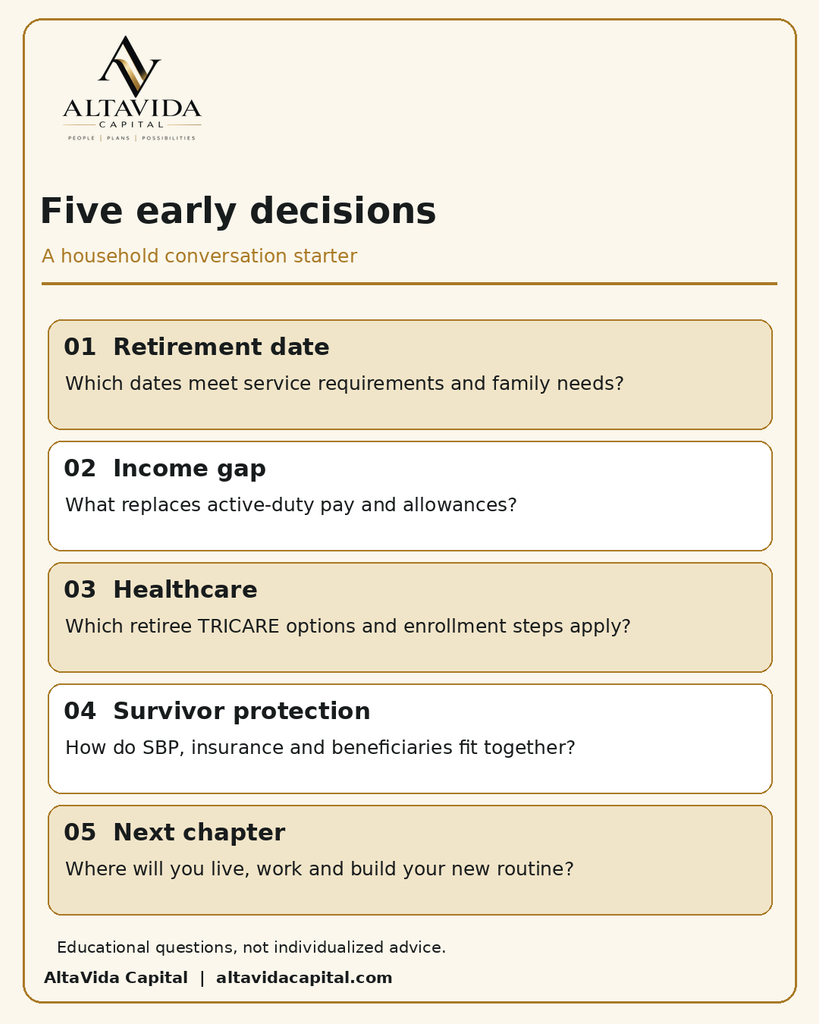
What should you decide together as a family?
A military retirement planning timeline is stronger when the household participates. Before putting a retirement date on the calendar, ask how the transition changes both partners’ opportunities, not only the service member’s pension. The following five questions are Socratic discussion prompts, not medical, tax, or individualized financial recommendations.
- If we retired earlier than planned, what would happen to our monthly cash-flow margin?
- Which survivor benefits and insurance resources would our family actually need?
- Would our preferred home location support civilian work, healthcare, schools and relationships?
- What assumptions are we making about VA claims or post-military employment that may not materialize?
- What should we keep flexible until the official retirement date and benefits are confirmed?
Three hypothetical military households
Example 1: an active-duty E-7 approaching 20 years
A fictional E-7 builds a military retirement planning timeline at 17 years of service. Rather than assume a particular pension, the family compares the applicable retirement system, service-specific eligibility and household expenses. A second income is treated as uncertain until there is a genuine job offer. This is a planning example, not an estimate of any individual’s retired pay.
Example 2: a military spouse comparing two locations
A military retirement planning timeline also affects a spouse weighing remaining near an installation against relocating for a civilian career. The family lists school and housing costs, access to retiree healthcare and the spouse’s earning opportunities. Their decision might favor a later move even when the service member could retire earlier.
Example 3: an Air National Guard member
A fictional Guard member has qualifying years for non-regular retirement but is not yet eligible to begin retired pay. The household avoids applying the active-duty first-payment assumptions to the Guard timeline; it checks retired-pay eligibility, healthcare and survivor elections under the applicable component rules.
Questions military households are asking
What month is the best month to retire from the military?
There is no universally best month. It depends on service requirements, personnel approval, pay timing, leave, civilian employment, family location and taxes. Compare your intended date against official branch guidance and the consequences of moving it.
What is the 180 day rule for military retirees?
The often-quoted 180-day rule refers principally to certain civilian appointments within the Department of Defense soon after retirement under 5 U.S.C. § 3326; the statute provides exceptions. It is not a blanket prohibition on all civilian work and does not automatically bar a private-sector job. Verify current personnel guidance before accepting an affected DoD appointment. [7][8]
What are the 7 signs that it’s time to retire?
No official military authority recognizes one universal seven-sign test. Useful considerations include eligibility, mission satisfaction, health and family priorities, readiness of finances, civilian career options, location needs and confidence in the transition plan. These are discussion factors, not a diagnostic checklist.
What is the #1 regret of retirees?
There is no defensible single “number-one regret” applicable to every military retiree. Instead, ask what you would regret leaving unresolved: missed time with family, unclear healthcare plans, insufficient liquidity or unexamined civilian opportunities. Individual experience varies.
What is the happiest age to retire?
There is no age that guarantees greater happiness. Military retirement eligibility does not necessarily align with civilian retirement or Social Security timing. A workable retirement date considers financial resources, purpose, relationships, health and preferences without pretending that a single age fits everyone.
What are five things I wish I knew before retirement?
Five common planning discoveries are that military compensation includes more than base pay; retiree medical coverage requires an enrollment decision; family survivor choices matter; paperwork can affect first-pay timing; and the spouse or partner has a transition too. Ask about these well before the final year.
Do you live longer if you retire early?
An individual cannot infer personal life expectancy from retirement timing alone. Studies of retirement and longevity vary in methods and populations and cannot establish that retiring early causes a particular outcome for a military member. Decisions involving health should include qualified medical input.
What month is best to retire financially?
The financial result depends on your approved retirement date, final active-duty pay and leave, retired-pay start, tax circumstances, and civilian income timing. Have the service finance office confirm processing dates and review the cash-flow transition rather than choosing a month from a generic rule.
How do you know it’s time to retire?
A military retirement planning timeline supports a sound decision when eligibility is documented, official deadlines are understood, household financial scenarios are realistic, healthcare and survivor choices are considered, and the member and family can explain what they want the next phase to look like.
Your next step: turn planning into a timeline
Start by writing down a tentative retirement date, five family decisions and the government offices responsible for the next deadlines. Then compare this early-stage military retirement planning timeline with AltaVida Capital’s [Military Retirement Checklist](https://www.altavidacapital.com/military-retirement-checklist/), which focuses more closely on the final 24–12 months and beyond. That companion resource prevents you from relying on a single broad article for every paperwork deadline.
For a broader educational starting point, visit [AltaVida Capital](https://www.altavidacapital.com/) to explore military-benefits education. Confirm actual eligibility, coverage, application dates and retirement calculations with the responsible service branch and government agencies before acting.
Optional next step: Use AltaVida Capital’s Military Benefits Assessment to organize your household’s questions: https://m-assessment.altavidacapital.com/. This is educational, not an official eligibility determination.
Educational disclosure
This information is general military-retirement education, not official service guidance or individualized insurance, tax, investment, legal or healthcare advice. Rules and available options differ by branch, retirement system and component and can change. Hypothetical examples are illustrative and do not predict actual benefit outcomes. Verify decisions with the relevant agency and appropriately qualified professionals.
05 | Official source register for further reading on your Military retirement planning timeline
[S1] Army Soldier for Life — Retirement Process — https://soldierforlife.army.mil/Army-Retirement/Retirement-Planning/Retirement-Process
Purpose: 24–36 month Army planning roadmap. Checked 2026-11-10.
[S2] Military OneSource — Military Retirement — https://www.militaryonesource.mil/resources/millife-guides/retirement-transition/
Purpose: TAP, counseling, pre-separation deadlines. Checked 2026-11-10.
[S3] Military OneSource — Transition Assistance Program — https://www.militaryonesource.mil/benefits/transition-assistance-program/
Purpose: TAP eligibility, early start. Checked 2026-11-10.
[S4] VA — Pre-discharge Claim — https://www.va.gov/disability/how-to-file-claim/when-to-file/pre-discharge-claim/
Purpose: BDD 180–90 days and eligibility. Checked 2026-11-10.
[S5] TRICARE — Retiring — https://tricare.mil/lifeevents/retiring
Purpose: retirement QLE; 90-day enrollment and potential retroactive enrollment request within 12 months. Checked 2026-11-10 and independently reconfirmed 2026-11-10.
[S6] DFAS — Retired Pay Schedule — https://www.dfas.mil/retiredmilitary/manage/payschedule/
Purpose: Monthly timing; paid on first day subject to weekends/holidays. Checked 2026-11-10.
[S7] U.S. Code — 5 USC 3326 — https://www.law.cornell.edu/uscode/text/5/3326
Purpose: DoD civilian appointment restriction. Checked 2026-11-10.
[S8] OPM — Vet Guide for HR Professionals — https://www.opm.gov/policy-data-oversight/veterans-services/vet-guide-for-hr-professionals/
[S9] AltaVida Capital — Military Retirement Checklist — https://www.altavidacapital.com/military-retirement-checklist/
Purpose: Existing downstream checklist; avoids duplication. Checked 2026-11-10.
[S10] Army Soldier for Life — 24–36 months out — https://soldierforlife.army.mil/Army-Retirement/Retirement-Planning/Retirement-Process/24-to-36-mths-out
Purpose: Early cash-flow and family planning. Checked 2026-11-10.