

Military Retirement Pay After 20 Years: E-7, Average Pension and DFAS Timing
Twenty years of military service may qualify an eligible active-duty member for a lifetime monthly pension, but the phrase “military retirement pay after 20 years” does not identify one universal dollar amount. Retired pay depends on the applicable retirement plan, retired-pay base, creditable service, and sometimes special circumstances. An E-7 can illustrate the math—but the gross estimate is not the same as the deposit a family will receive. [1][2]
How is military retirement pay after 20 years calculated?
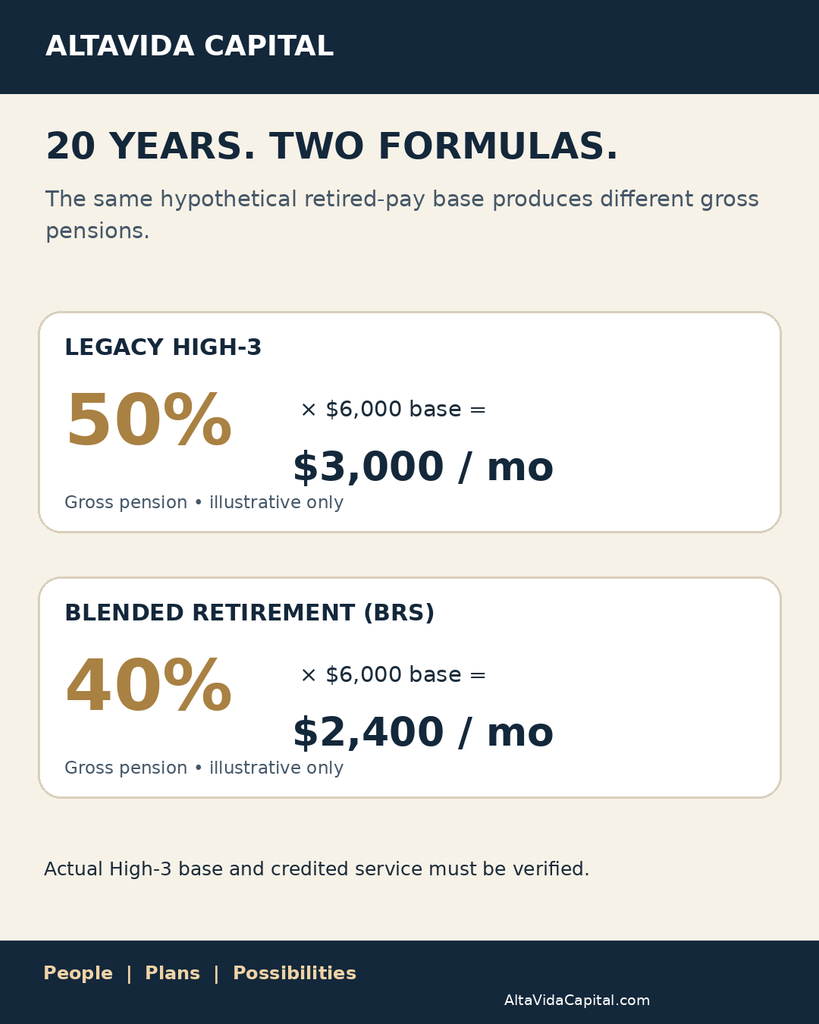
For military retirement pay after 20 years under a typical nondisability active-duty retirement, a simple starting point is retired-pay base × years-of-service multiplier. Legacy High-3 generally accrues 2.5% for each year of service; BRS generally accrues 2.0% for each year. At 20 years, those multipliers are 50% and 40%, respectively. High-3 uses the average of the highest 36 months of basic pay; some other historical plans and special retirements follow different rules. [1][2]
| Retirement plan | 20-year multiplier | If retired-pay base is $6,000/month |
| Legacy High-3 | 50% | $3,000 gross/month |
| Blended Retirement System (BRS) | 40% | $2,400 gross/month |
These military retirement pay after 20 years examples are deliberately hypothetical. They are not official quotes for an E-7, and the BRS comparison considers only the defined-benefit pension—not BRS TSP contributions, matching or investment outcomes. The active-duty 2026 basic-pay table alone cannot reveal a specific member’s highest-36-month average. [1][3]
What is retirement pay for E7 with 20 years?
To estimate military retirement pay after 20 years, a member should first verify the relevant retirement plan, retirement date, actual completed years and months of creditable service, and the historic monthly basic-pay amounts used in the retired-pay base. The 2026 DFAS enlisted-pay table reports an E-7 monthly basic-pay rate of $6,245.70 in the over-20-years column. That is a current basic-pay-table entry, not a certified High-3 pension base, and does not itself establish the retired-pay amount of someone who retires with exactly 20 years. [3]
Military retirement pay after 20 years example: If an E-7 has a verified High-3 base of $6,000, 20 creditable years, and legacy High-3 coverage, 50% × $6,000 yields $3,000 in gross monthly retired pay. If the same assumed pay base and service length were subject to BRS, 40% × $6,000 yields $2,400 gross per month. The illustration isolates the pension formula; it does not compare total compensation or plan suitability. [1][2]
Which figure matters most to your household—the gross pension shown in an estimate, or the monthly amount available after taxes, premiums and other deductions?
Why gross military pension pay differs from take-home pay
For military retirement pay after 20 years, DFAS issues a Retiree Account Statement (RAS) showing the account’s gross pay, deductions and net pay. Applicable federal tax withholding, Survivor Benefit Plan (SBP) premiums, allotments, legal deductions, or VA-related adjustments may change the deposit. State treatment of military retired pay varies. Ordinary basic allowances such as BAH and BAS are not simply carried into the pension calculation. Individual tax questions belong with a qualified tax professional. [4][5]
Hypothetical family: the difference is in the deposit
A family evaluating military retirement pay after 20 years uses a $3,000 gross monthly E-7 pension illustration to prepare a household budget. They intentionally do not assume that $3,000 will arrive in their bank account. Instead, they review the DFAS RAS when issued and update their plan for actual deductions, healthcare premiums, survivor elections and any other household income. The question is not whether the illustration is attractive—it is whether the verified net cash flow covers their essential expenses.
If the first payment is delayed or lower than expected, which expenses must the household still cover on time?
When does DFAS send the first military retirement payment?
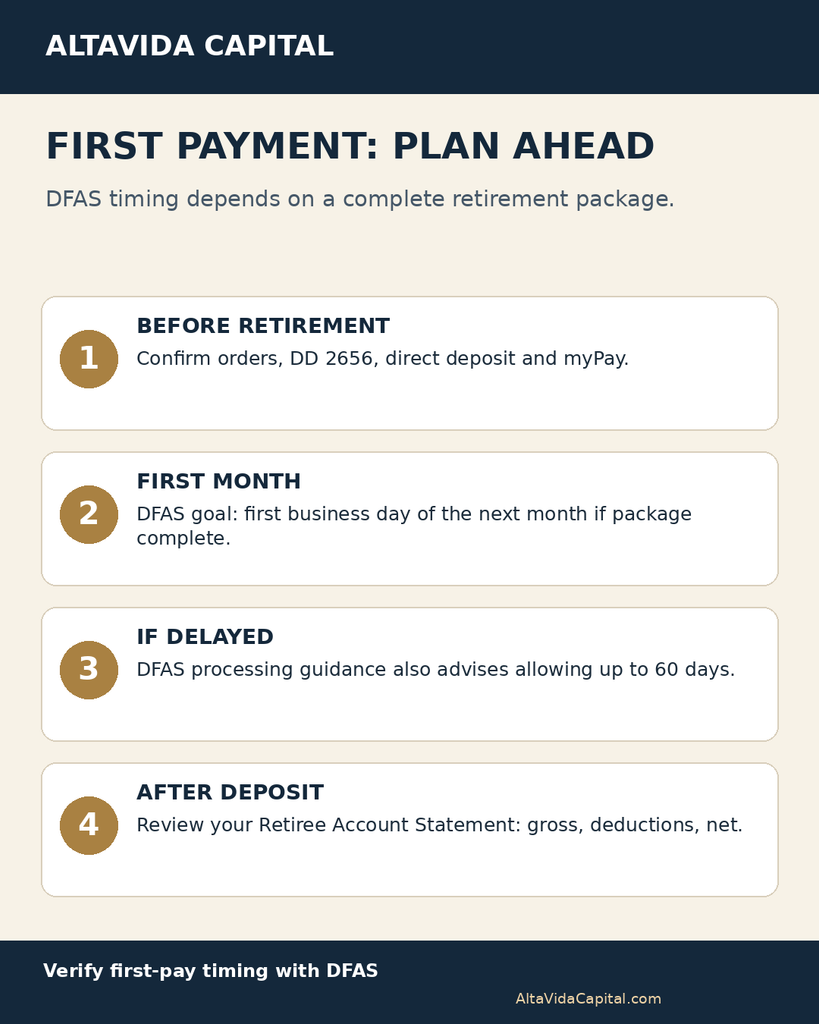
For military retirement pay after 20 years, DFAS’s March 2026 guidance says its goal is to issue the first retired-pay payment on the first business day of the month following retirement, provided it receives a complete and correct retirement package, including a signed DD Form 2656. A separate DFAS processing reference tells retirees to allow up to 60 days for the first payment to be processed. Neither statement guarantees a specific individual deposit date. Retired pay is generally due on the first day of the month, with the applicable schedule adjusted for weekends and holidays. [5][6]
Hypothetical family: the transition-month gap
A service member retires at the end of a month, expecting the household’s expenses to continue uninterrupted. Rather than spending on the assumption that retired pay will arrive immediately, the family confirms its retirement packet, keeps myPay access current, checks bank details and maintains a practical cash-flow cushion. After the first deposit they reconcile the RAS against their initial estimate. [5][6]
Has your family confirmed that DFAS received a complete retirement packet, or are you relying on the date printed on the retirement orders?
Can a military retiree lose their pension?
Military retired pay does not routinely disappear merely because a retiree starts civilian work. But payment or entitlement can be affected by specific law and circumstances. DFAS says retired pay stops while a retiree recalled to active duty is receiving active-duty pay; payment can resume or be recomputed after the recall. VA disability compensation can lead to a retired-pay offset, while CRDP or CRSC may affect the net result for eligible people. Other rare legal forfeitures or government debt recoupments require fact-specific review. An offset or temporary suspension must not be described as automatic permanent pension forfeiture. [7][8]
What is the average military pension?
There is no meaningful one-size-fits-all average for military retirement pay after 20 years or for an E-7 pension. As a broad historical benchmark, the Defense actuarial valuation dated September 30, 2024 reports approximately 1.919 million nondisabled retirees and $70.51 billion in annualized retired pay for that population. Dividing those aggregate numbers produces roughly $3,062 per month per reported nondisabled retiree. This is a simple aggregate estimate, not an individual entitlement, not a 2026 average, and not an average for newly retired E-7 members. [9]
Is a systemwide pension average useful for your actual retirement budget—or is your verified service record and retired-pay base the real starting point?
What percentage of military members actually retire?
When evaluating who receives military retirement pay after 20 years, the FY2024 valuation uses a demographic assumption that 19% of a typical new full-time entrant cohort and 17% of a typical part-time entrant cohort will serve at least 20 years. These are actuarial modeling assumptions for entrants, not measured percentages of all people who separated in one specific year. Qualifying for a traditional active-duty pension should also be distinguished from vesting in BRS TSP benefits. [9]
What rank do most military retire at?
Military retirement pay after 20 years varies by rank, but there is no single rank we can responsibly present as “the most common” without defining the population—active-duty enlisted, officers, all services, Guard/Reserve, and a specific reporting year—and checking a matching official statistical table. E-7 is used here because readers frequently ask for an E-7 calculation; it is not evidence that E-7 is the modal retirement grade. This question remains open for a source-specific follow-up rather than an unsupported numerical claim.
Is military retirement going up in 2026?
Military retirement pay after 20 years may receive cost-of-living adjustments (COLAs), which are distinct from the annual increase to active-duty basic pay. The applicable retired-pay COLA and its first-year effects depend on the retirement plan and other eligibility details. Check the official DoD retired-pay COLA guidance and the current DFAS RAS instead of assuming the active-duty pay raise applies to an individual retiree. [10]
How long does it take DFAS to process retirement pay?
For military retirement pay after 20 years, DFAS aims to begin the first payment on the first business day of the month after retirement when a complete package is received. Its processing guidance also advises up to 60 days for first-pay processing. If the payment has not arrived, confirm the documents and status through official DFAS channels rather than assuming the pension was lost. [5][6]
A practical military retired-pay checklist
Verify the retirement plan, service dates, and retirement order.
Confirm the retired-pay base from actual basic-pay records.
Calculate gross pay using the correct multiplier.
Check DFAS packet completion and DD Form 2656.
Prepare for tax withholding, SBP premiums, VA offsets and other deductions when applicable.
Review the first RAS and reconcile gross and net amounts.
Compare expected net cash flow with essential household expenses and survivor needs.
Before you make the next retirement decision
Military retirement pay after 20 years is a starting point, not a complete family income strategy. Compare your verified pension estimate with survivor protection, insurance coverage, healthcare costs, TSP resources and the household’s timing needs. Our existing military retirement checklist explains the broader transition steps, and our military retirement benefits review discusses how the pieces fit together. [11][12]
What happens if your expected income changes—and which family member would need to make the next decision?
Explore the Military Benefits Assessment: https://m-assessment.altavidacapital.com/ — an educational tool for organizing benefits and protection questions. It does not determine federal eligibility, calculate an official pension, recommend a product, or replace DFAS or professional guidance.
Sources and verification references
[1] DoD retired-pay calculation methods — https://militarypay.defense.gov/Pay/Retirement/Calculator/
[2] DoD active-duty retirement plans — https://militarypay.defense.gov/Pay/Retirement/ActiveDuty/
[3] DFAS 2026 enlisted basic-pay table — https://www.dfas.mil/MilitaryMembers/payentitlements/Pay-Tables/Basic-Pay/EM/
[4] DFAS overview of estimated retired pay — https://www.dfas.mil/RetiredMilitary/plan/estimate/
[5] DFAS Helpful Tips & Tools for New Retirees (March 2026) — https://www.dfas.mil/Portals/98/Documents/RetiredMilitary/forms/DFAS%20Helpful%20Tips%20Ret%20Pay%202026.pdf?ver=HeOEMdt-UqVZNGUd8WI6cQ%3D%3D
[6] DFAS first-pay processing timelines — https://www.dfas.mil/RetiredMilitary/about/How-Long-Does-It-Take/
[7] DFAS recall to active duty — https://www.dfas.mil/RetiredMilitary/plan/recall/
[8] DFAS VA disability offset / retired-pay types — https://www.dfas.mil/retiredmilitary/plan/retirement-types/
[9] DoD Office of the Actuary, FY2024 valuation pp. 4–5 — https://actuary.defense.gov/Portals/15/FY%202024%20MRF%20Val%20Report%20Final.pdf?ver=GTq-YoUuJhg15NNgUYJ4SQ%3D%3D
[10] DoD retired-pay COLA explanation — https://militarypay.defense.gov/Pay/Retirement/cola/
[11] AVC military retirement checklist — https://www.altavidacapital.com/military-retirement-checklist/
[12] AVC military retirement benefits review — https://www.altavidacapital.com/military-retirement-benefits-review/
Educational information only. Actual retirement eligibility, official estimates, disability-related payments, federal or state taxes, and benefit elections depend on individual records and law. Confirm benefit details with DFAS and your service; obtain licensed legal, tax, or insurance advice where appropriate. AltaVida Capital is not affiliated with or endorsed by the Department of Defense or DFAS. Reviewed November 17, 2026.