
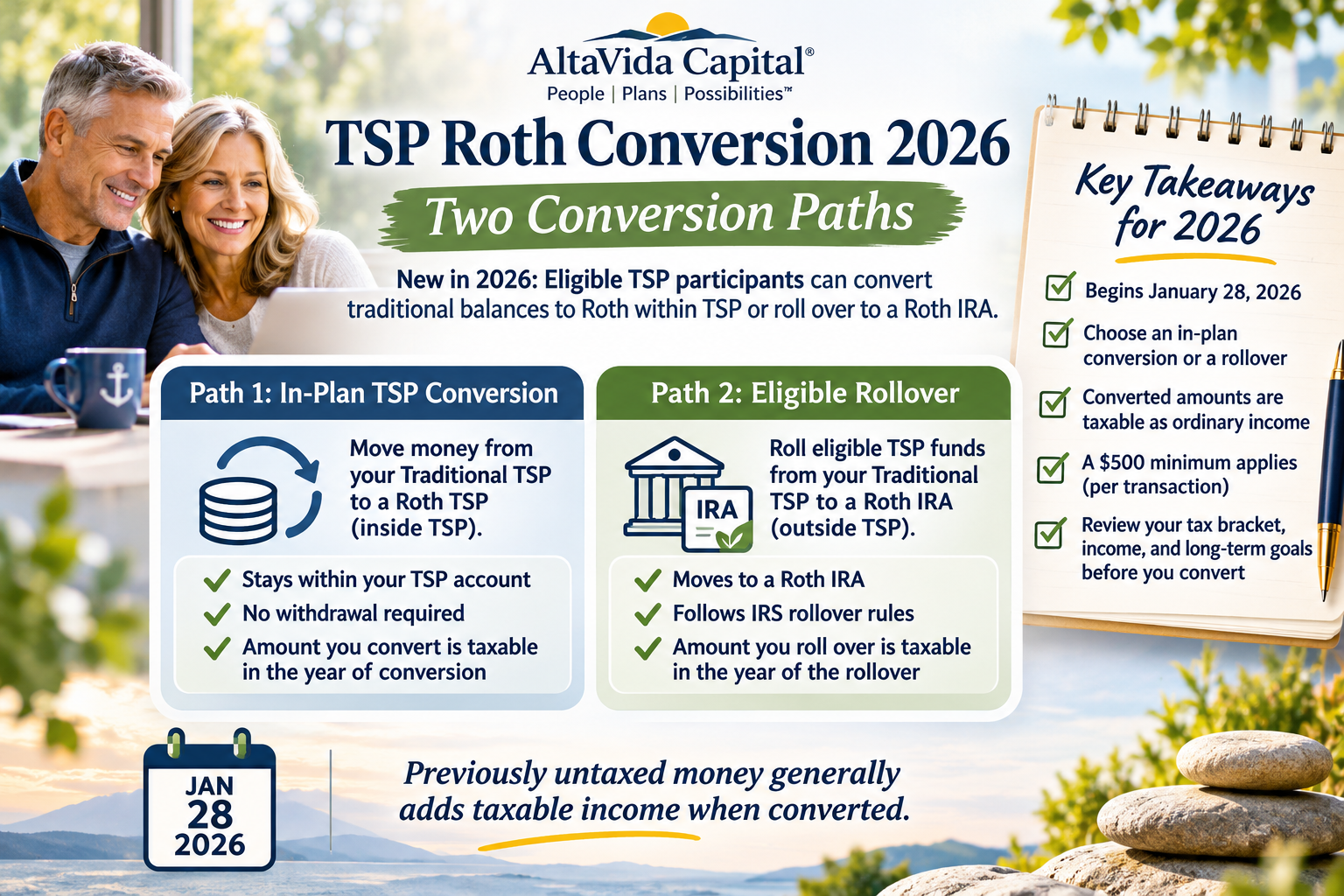
Yes. Beginning January 28, 2026, the Thrift Savings Plan (TSP) permits eligible participants to convert traditional TSP balances to Roth TSP balances inside TSP. The Federal Retirement Thrift Investment Board (FRTIB) adopted this in-plan option effective that date. It is a different transaction from receiving an eligible TSP distribution and rolling it into a Roth IRA outside the plan. Previously untaxed traditional money generally becomes taxable income when converted by either route. [1][2][3]
Understanding the TSP Roth conversion 2026 rules can help federal employees and uniformed service members evaluate their options before requesting a conversion.
The new feature matters to federal civilian employees, uniformed service members, and people who retain qualifying TSP accounts after separation or retirement. A new legal option does not mean every account can convert every dollar today: minimums, retained balances, administrative holds, investment restrictions, and required minimum distributions (RMDs) can affect an actual request. [1][2]
What changed on January 28, 2026?
Before the new feature, changing how future contributions are designated did not transform existing traditional balances into Roth balances. With TSP’s 2026 in-plan conversion feature, eligible traditional account money can instead move into Roth treatment without leaving the plan. The applicable regulation is 5 CFR §1650.60, published January 15, 2026 and effective January 28, 2026. FRTIB’s January 2026 meeting report also described participant launch communications and an account-based calculator. [1][2]
Traditional TSP, Roth TSP and Roth IRA: three separate concepts
Traditional TSP generally contains pretax employee or employer contributions and deferred earnings, plus potentially separately tracked tax-exempt uniformed-service contributions. Roth TSP is the designated Roth balance within the federal plan; eligible qualified distributions may be tax-free subject to applicable requirements. Roth IRA is an individual retirement account outside the TSP, with different rules and features. Choosing Roth for future payroll contributions is not the same as converting an existing traditional balance. [3][4]
Who can use a TSP in-plan Roth conversion?
The rule permits requests by active TSP participants; separated and retired participants who maintain TSP accounts; and eligible surviving-spouse beneficiary participants with established beneficiary participant accounts. This can include civilian and uniformed-services TSP accounts. Non-spouse beneficiaries and alternate payees cannot request this TSP in-plan conversion. General IRS rules for other workplace plans should not be confused with these TSP-specific limits. Verify actual transaction eligibility in My Account, including any restrictions. [1][2]
What are the $500 and annual transaction rules?
- Minimum conversion request: $500; the requester must have a vested balance of at least $500.
- Regulatory annual maximum: Under 5 CFR § 1650.60(a), a participant or beneficiary participant may request up to 26 in-plan Roth conversions per calendar year. This is a maximum, not a guaranteed number of approved conversions or a requirement to make conversions on a biweekly schedule. Multiple requests within one pay period are not categorically prohibited by the rule.
- TSP account administration: At its January 27, 2026 board meeting, FRTIB described the operational limit as up to 26 per account per calendar year. That account-level description explains TSP administration; it does not create an extra legal entitlement beyond the published rule. Anyone maintaining both civilian and uniformed-services accounts should confirm how TSP applies the limit to those accounts before submitting requests.
- Retained balances: participants must retain at least $500 in each applicable tax-deferred employee, tax-exempt contribution, agency automatic (1%), and agency matching contribution balance identified by the rule. This is not one flat $500 requirement across the entire account.
- Mutual Fund Window: amounts there must first be moved back to core TSP funds before conversion.
- Administrative holds: can prevent a conversion request.
- RMDs: when due, the full required distribution must be satisfied before an in-plan conversion. An RMD itself cannot be converted.
These restrictions apply to in-plan conversions; they should not be mechanically transferred to Roth IRA rollover rules. [1][2]
Are Roth conversions taxable in 2026?
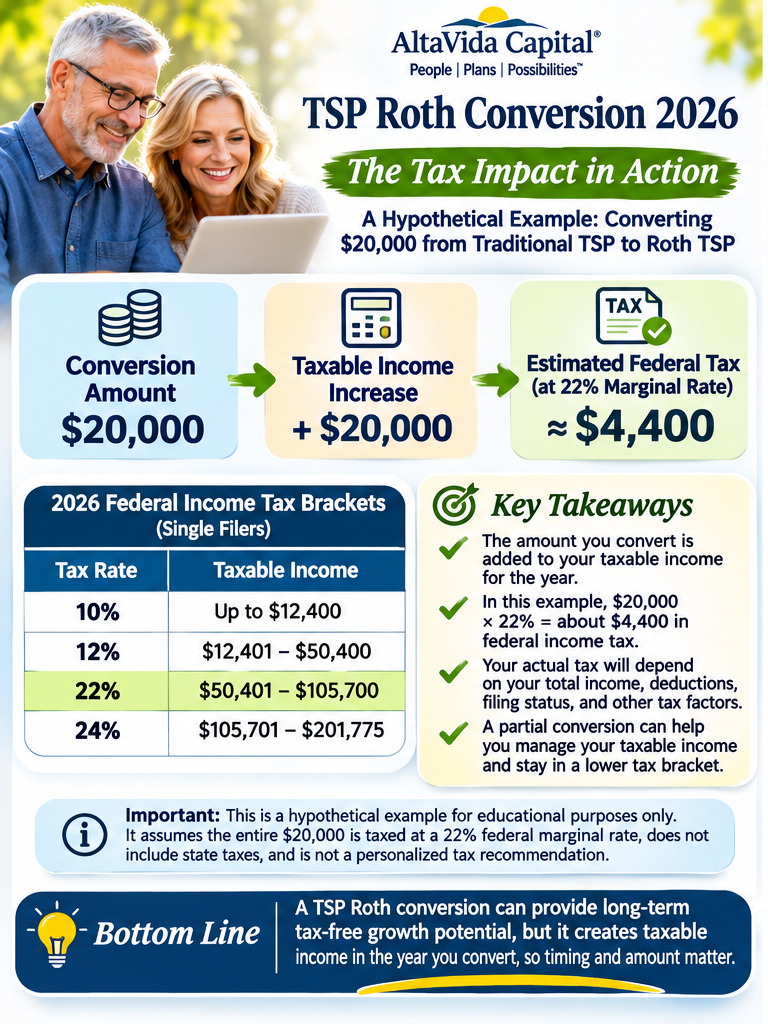
Generally, yes for previously untaxed money. An in-plan conversion from traditional pretax TSP into Roth TSP generally increases income in the calendar year the conversion occurs. A direct in-plan conversion generally does not have income tax withheld from the converted amount. The participant therefore needs to consider other cash resources, estimated taxes or adjusted withholding. Conversions cannot be undone by recharacterization, and special five-year recapture and Roth qualified-distribution rules can matter when money is later withdrawn. [1][3][4]
Hypothetical example 1: A federal retiree converts $20,000 of entirely pretax traditional TSP funds to Roth TSP in 2026, and the conversion is permitted under their actual account limitations. Generally, $20,000 is included in 2026 gross income. That is not a $20,000 tax bill: the additional income tax depends on their filing status, other taxable income, deductions, state treatment and other circumstances. The example assumes no tax-exempt basis and does not estimate tax savings.
What is different for military TSP tax-exempt contributions?
Traditional uniformed-services TSP balances may include amounts contributed from tax-exempt combat-zone pay. Under the final TSP regulation’s explanation, both the pre-tax and tax-exempt portions may be involved in a conversion, but pro rata requirements mean a conversion proportionally includes each component based on the traditional balance. The already tax-exempt contribution component is not simply treated as previously untaxed pretax income; earnings and other funds may have different tax treatment. Participants should confirm their recorded tax-exempt balance and projected taxable portion with TSP and a qualified tax professional. Do not assume the participant can isolate only tax-exempt funds for conversion. [1]
An in-plan conversion versus a Roth IRA rollover
| Feature | In-plan conversion | Eligible traditional TSP rollover to Roth IRA |
| Destination | Roth TSP, inside TSP | Roth IRA, outside TSP |
| Need TSP distribution eligibility? | Not necessarily: this separate feature can reach otherwise nondistributable balances | Yes, funds must qualify for distribution and rollover |
| TSP conversion minimum/frequency | $500 request; regulatory maximum of 26 per calendar year (see account-administration clarification above) | These particular in-plan conversion limits do not define IRA rollovers |
| Tax | Previously untaxed converted amounts generally taxable | Previously untaxed eligible rollover amounts generally taxable |
| Decision factors | TSP plan rules, RMDs, retained balances, account restrictions | IRA custodian, distribution eligibility, rollover procedure, IRA features |
Roth IRA rollovers require separate eligibility analysis and proper transaction execution; a direct rollover can avoid mandatory cash-distribution withholding, but it does not remove tax on converting pretax money to Roth. [3][5][6]
Hypothetical example 2: A separated uniformed-service participant has a $40,000 eligible for distribution, entirely pretax traditional TSP balance and arranges a direct rollover to a Roth IRA. Generally, the $40,000 is included in income for the rollover year. This assumes no tax-exempt contributions, no RMD portion, and valid direct rollover execution. Actual availability, taxable basis and IRA terms must be confirmed.
Will converting my traditional TSP to a Roth IRA be allowed in 2026?
Yes, when the TSP amount is eligible for distribution and rollover. An outside Roth IRA rollover and the newly available TSP in-plan Roth conversion are separate legal and operational paths. [3][5]
Can I move my military TSP to a Roth IRA?
Potentially, if you qualify for a permitted distribution and rollover. Military participants should check pretax versus tax-exempt components, status, any withdrawal restrictions, and how the receiving IRA handles the transfer. [1][5]
Is it tax-free to convert TSP to a Roth IRA?
Not ordinarily when previously untaxed traditional money is converted. A direct transfer or rollover helps manage the transfer mechanics, not the income-tax character of the pretax converted funds. [3][6]
When should you not convert traditional to Roth?
No universal yes/no rule applies. A conversion deserves extra scrutiny when the added income could trigger a higher marginal rate, change income-based charges or benefits, affect liquidity needed for tax payments, or conflict with future withdrawal plans. Consider your full tax picture rather than a single headline bracket. [3][4]
What is the best thing to do with your TSP when you retire?
There is no universal best choice. Leaving qualified funds in TSP, making permitted withdrawals, an in-plan conversion, or an eligible rollover can have different costs, flexibility, beneficiary consequences and tax results. The question is which choice addresses your actual retirement objectives. [3][5]
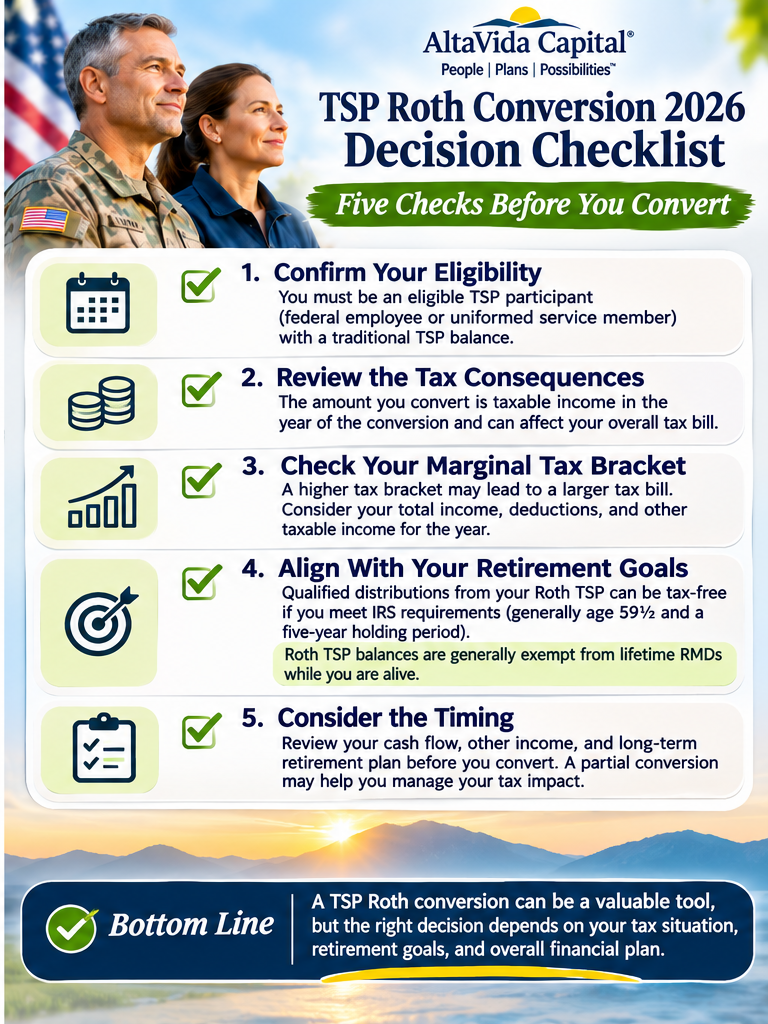
Five checks before deciding
- Which transaction? An existing balance moved inside TSP, an eligible rollover outside TSP, or new Roth contributions?
- Does my account qualify? Check status, minimums, retained balances, holds, RMDs, and receiving-account instructions.
- What really becomes taxable? Separate pretax money, tax-exempt military basis, and other tracked components.
- How will the tax be funded? Obtain a tax projection that considers the entire year, not just the conversion.
- Why this transaction now? What specific retirement or family objective would it serve, and what alternative would you be giving up?
Your retirement decision may involve more than the TSP
If you are approaching military or federal retirement and reviewing your family protection or survivor-benefit needs, AltaVida Capital provides general educational resources and an opportunity to request a conversation with a licensed insurance professional about insurance-related questions. The TSP transaction itself, rollover recommendations and tax calculations should be reviewed with TSP and appropriately qualified tax and financial professionals.
Disclosure: Educational information only; not personalized investment, tax, legal, insurance suitability or federal-benefits-election advice. TSP eligibility and tax treatment vary by account and circumstances. There is no guarantee a conversion will reduce lifetime taxes. AltaVida Capital does not represent TSP, FRTIB or the federal government. This content should be rechecked when TSP or IRS rules change.
Official sources (reviewed November 6, 2026)
- FRTIB final rule, Roth In-Plan Conversions, published Jan 15, 2026, effective Jan 28, 2026. https://www.federalregister.gov/d/2026-00765
- FRTIB January 2026 board meeting minutes, eligibility, calculator, limits and launch description. https://www.frtib.gov/meeting_minutes/2026/2026Jan.pdf
- IRS, Retirement topics — Designated Roth account, in-plan rollovers and tax. https://www.irs.gov/retirement-plans/plan-participant-employee/retirement-topics-designated-roth-account
- IRS, Retirement plans FAQs on designated Roth accounts, conversion, tax and recapture. https://www.irs.gov/retirement-plans/retirement-plans-faqs-on-designated-roth-accounts
- IRS, Retirement plans FAQs regarding IRAs, eligible rollovers and exclusions. https://www.irs.gov/retirement-plans/retirement-plans-faqs-regarding-iras
- IRS, Publication 590-A (2025 edition as currently available), IRA rollover chart/tax. https://www.irs.gov/publications/p590a