

Roth Conversions Medicare IRMAA
Can a Roth conversion in 2026 increase Medicare premiums in 2028? Yes. The taxable portion of a Roth conversion generally increases adjusted gross income (AGI) for the year. Social Security usually uses tax information from two years earlier to determine Medicare income-related monthly adjustment amounts (IRMAA). A taxable 2026 conversion could therefore increase Part B—and, if enrolled in Medicare Part D, Part D—costs in 2028. Whether it actually does depends on total income, filing status, Medicare enrollment and the thresholds applicable in 2028. [1][3][4]
The relevant question is not simply “Should I avoid IRMAA?” It is “How does the potential Medicare cost fit into the overall tax and retirement-income decision?” Military retirees can also review the AltaVida Capital Military Retirement Benefits resource.
Roth Conversions Medicare IRMAA: What Military Retirees Should Know
Roth Conversions Medicare IRMAA planning is particularly important for military retirees who receive military retired pay, Social Security benefits, or taxable investment income. A Roth conversion can increase taxable income in the year the conversion occurs. Because Medicare generally uses income information from two years earlier to determine income-related monthly adjustment amounts (IRMAA), converting retirement funds in 2026 could affect Medicare premiums in 2028. The actual impact depends on total income, tax filing status, Medicare enrollment, and the thresholds applicable in 2028.
Do Roth conversions count as income for Medicare premiums?
Generally, yes, to the extent the conversion is taxable. Converting pre-tax traditional IRA money to a Roth IRA creates ordinary income for that tax year. Previously taxed IRA basis may reduce the taxable portion, requiring correct reporting such as Form 8606 where applicable. Contributing to a Roth IRA is not the same transaction as converting a pre-tax traditional IRA. [1][2]
For IRMAA, Medicare modified adjusted gross income (MAGI) generally means AGI plus tax-exempt interest. A conversion may increase MAGI even if converted funds are never withdrawn for living expenses. Military retired pay, other pension income, wages, taxable Social Security and investments also may affect AGI. [3]
What happens when a conversion is added to a year that already includes military retired pay, Social Security or capital gains?
Why a 2026 conversion may affect 2028 premiums
Medicare IRMAA generally uses income tax data from two years earlier. Thus 2026 premiums generally rely on 2024 tax information, and 2028 premiums would generally rely on 2026 tax information. SSA may use older available records or accept updated data in specified circumstances. [3]
Organize your military retirement, TSP, TRICARE, survivor protection, and family benefits questions with our educational assessment. Receive a readiness snapshot identifying areas that may deserve closer review.
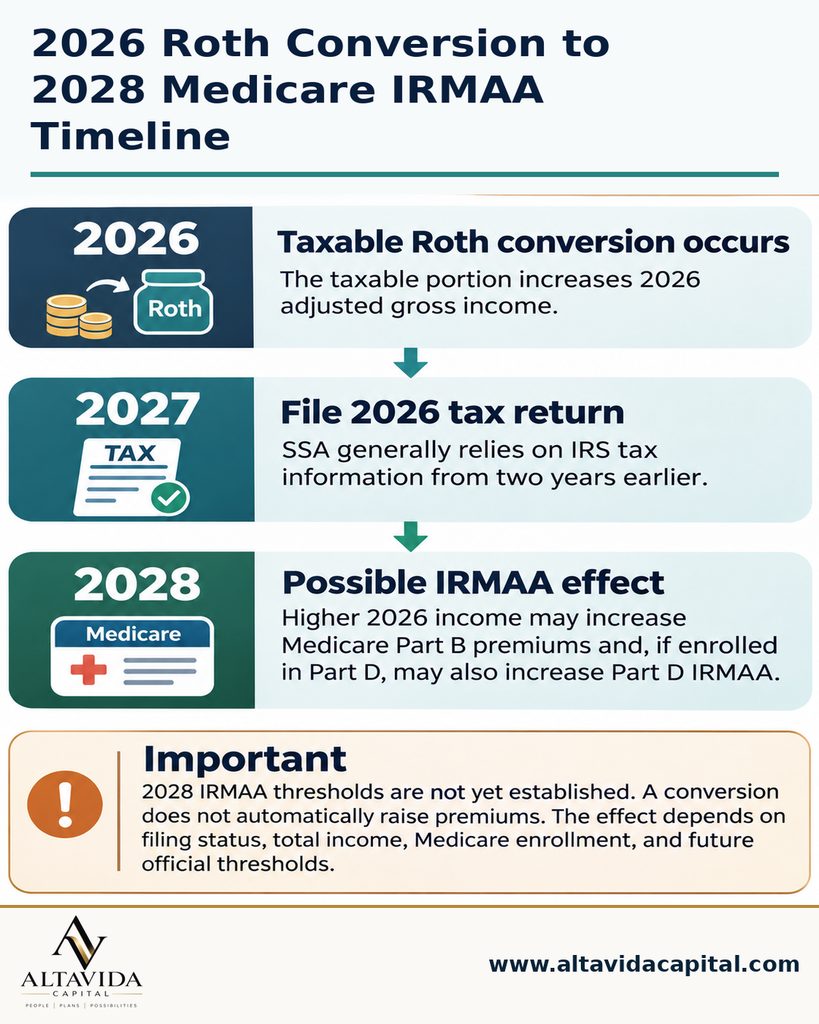
A 2026 conversion does not automatically increase IRMAA. A change depends on whether total MAGI crosses an applicable premium-year threshold. The 2028 thresholds and premiums should be checked only when officially established; 2026 figures must not be treated as 2028 forecasts.
How Roth Conversions Medicare IRMAA Planning Affects TRICARE For Life
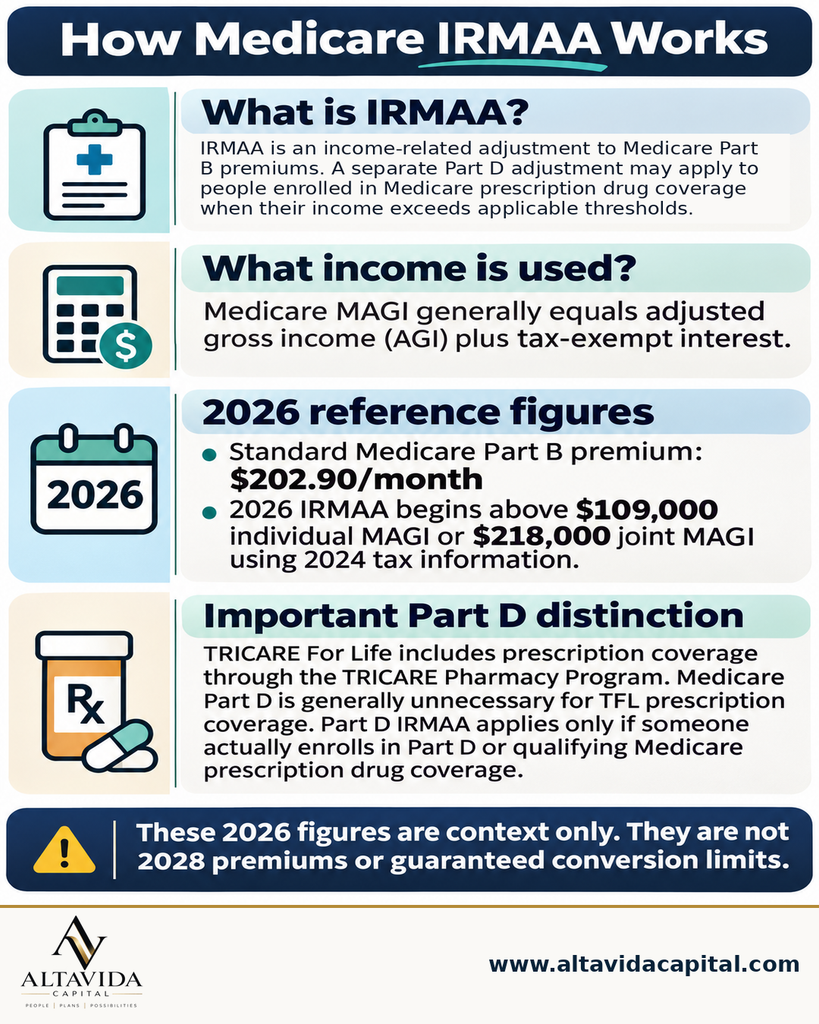
For military retirees with TRICARE For Life, understanding Roth Conversions Medicare IRMAA interactions can help distinguish Medicare Part B costs from prescription drug coverage. TRICARE For Life includes prescription benefits through the TRICARE Pharmacy Program, so Medicare Part D enrollment is generally unnecessary. However, a taxable Roth conversion may increase Part B IRMAA. A separate Part D income-related adjustment may apply if the retiree enrolls in Medicare Part D and exceeds the applicable income threshold.
How does Medicare IRMAA work?
IRMAA is an income-related adjustment to the standard Medicare Part B premium, and a separate additional charge for people enrolled in Medicare Part D prescription drug coverage when applicable income thresholds are exceeded. Filing status and MAGI matter; Medicare Part D plan premiums vary by plan. [3][4]
For 2026, the standard Part B premium is $202.90 monthly. Under the 2026 premium-year thresholds, IRMAA generally begins above $109,000 MAGI for an individual filer and above $218,000 for married joint filers. The 2026 premium-year calculations usually reference 2024 income. These are not 2028 thresholds or safe conversion limits. Different married-filing-separately rules apply. [3][4]
Would a potential Medicare surcharge change your view of the conversion’s longer-term tax benefits?
Three hypothetical retirement situations
Example 1 — Military retiree near an income threshold. A hypothetical military retiree receives retired pay and taxable investment income. A proposed taxable Roth conversion increases AGI. Their tax preparer compares no conversion with smaller conversions over multiple tax years. The example illustrates income timing; it does not assume future brackets or guaranteed savings.
Example 2 — Military retiree with TRICARE For Life. A hypothetical military retiree with Medicare Parts A and B has TRICARE For Life (TFL). TFL includes prescription coverage through the TRICARE Pharmacy Program, so Medicare Part D is generally not needed to retain prescription benefits. The retiree must pay applicable Medicare Part B premiums, including any Part B IRMAA. If they separately enroll in Medicare Part D, Part D IRMAA may also apply when their income exceeds applicable thresholds. TFL pharmacy coverage alone does not create Part D IRMAA. A Part D plan may sometimes offer additional benefits, but its enrollment costs and drug formulary require individual comparison. [7][8][10][11]
Organize military retirement questions through the Military Benefits Assessment overview. This is an educational assessment, not an IRMAA or Roth conversion calculator.
Example 3 — Household converting before Medicare enrollment. A hypothetical couple evaluates whether converting before a spouse enrolls in Medicare may affect future premiums. They compare enrollment dates, filing status and projected income across years. An IRMAA charge on a coverage component generally depends on actual enrollment in that component during the premium year; age alone is not enough to determine its application. [3]
How can you avoid unnecessary Medicare IRMAA exposure?
There is no universal strategy to avoid IRMAA. Start with multi-year projections of taxable income, conversions and anticipated Medicare enrollment. Partial conversions across several years may be worth comparing with one large conversion, but future tax rates, timing, available funds and retirement goals can make either approach more or less appropriate.
Review military retired pay, wages, Social Security, investment gains, tax-exempt interest, filing status and any required minimum distributions. RMD amounts themselves cannot be converted. Qualified tax professionals can model projected tax and premium effects. [2]
Which matters more to your household: a possible near-term IRMAA charge or the long-term tax cost of leaving funds pre-tax?
When might a Roth conversion be less attractive?
A conversion may be less attractive if it creates taxes the household cannot fund comfortably, substantially raises marginal taxes or Medicare costs, interacts negatively with income-sensitive benefits, or conflicts with the household’s time horizon. None alone makes conversion categorically unsuitable. Roth IRA conversions generally cannot be reversed by recharacterization under current law. [2]
The related questions “When should you not do a Roth conversion?”, “When not to do a Roth conversion?” and “Who should not do a Roth conversion?” all require individualized analysis of tax cost, liquidity, goals and alternatives.
Can you appeal IRMAA after a Roth conversion?
An IRA conversion by itself is not a qualifying Social Security life-changing event for requesting a new IRMAA determination. SSA specifically identifies an IRA conversion as a nonqualifying one-time increase in income. Certain other events, such as work stoppage, work reduction, marriage, divorce or loss of spouse, can qualify. Corrected or amended tax records may support separate review procedures. Follow the notice and SSA procedures rather than assuming the conversion is grounds for relief. [5][6]
If retirement changes your household income, what documents would you need to request SSA reconsideration?
What is the average Medicare premium for a 65-year-old?
There is no single individual Medicare premium that applies to everyone aged 65. For 2026, the standard Part B premium is $202.90 monthly, with potential additions for IRMAA or late enrollment. Part D plan premiums vary. The standard Part B premium is not an age-specific national average. [4]
Who pays 75% of Medicare Part B?
Under the standard financing structure, beneficiary premiums are generally set to cover approximately one quarter of Part B costs while federal contributions cover most of the remainder. This does not mean the government pays exactly 75% of an individual medical bill. Higher-income beneficiaries may pay more through IRMAA. [9]
Roth Conversions Medicare IRMAA: Questions Before You Convert
Effective Roth Conversions Medicare IRMAA planning involves evaluating more than the immediate tax consequences. Before converting traditional retirement funds, military retirees should compare their projected taxable income, potential Medicare premium adjustments, available funds to pay conversion taxes, and longer-term retirement objectives. A qualified tax professional can model different conversion amounts and tax years to help determine whether the potential benefits justify the current tax expense and possible future Medicare costs.
Roth conversion and Medicare checklist
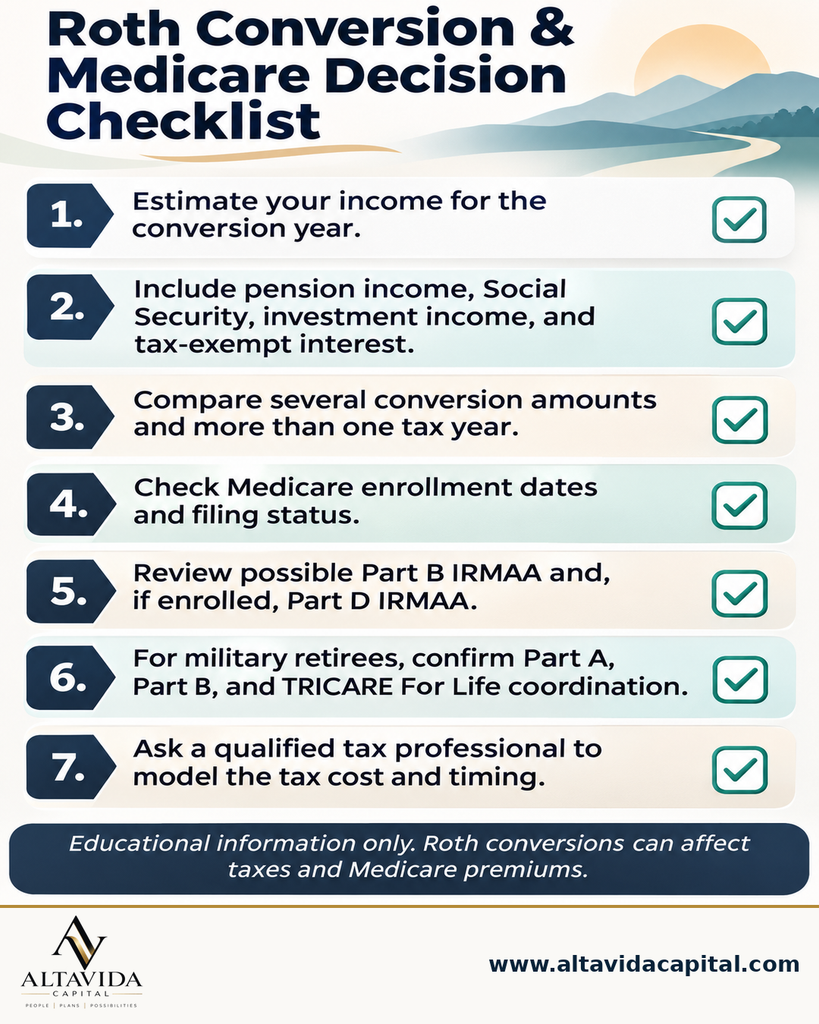
1. Estimate conversion-year AGI and Medicare MAGI, including tax-exempt interest.
2. Compare conversion amounts across several years.
3. Confirm anticipated Medicare enrollment and filing status.
4. Check premium-year Part B and (if enrolled) Part D IRMAA rules.
5. For military retirees, confirm Parts A and B and TFL coordination.
6. Ask a qualified tax professional to model taxation, basis and RMD limits.
7. Plan how any conversion tax will be paid.
What would you want to know before choosing a conversion amount?
A practical next step in your Roth Conversions Medicare IRMAA decision
Begin with military retirement records and expected income sources. Read the Military Retirement Benefits resource [AVC-A], then organize questions using the Military Benefits Assessment overview [AVC-B]. For individualized conversion and tax analysis, consult a qualified tax professional. For an optional discussion of insurance protection and retirement income coordination within licensed insurance scope, contact AltaVida Capital.
Official Government Sources and References
The following government resources provide additional information about Roth conversions, Medicare income-related monthly adjustment amounts (IRMAA), Medicare premiums, and TRICARE For Life.
1. Internal Revenue Service (IRS) — Roth IRA Conversions
The IRS explains how conversions from traditional IRAs to Roth IRAs are taxed, including the treatment of previously untaxed retirement funds.
IRS: Frequently Asked Questions Regarding IRAs
2. Social Security Administration (SSA) — Medicare Premiums and IRMAA
Social Security explains how modified adjusted gross income (MAGI), tax filing status, and prior-year tax information affect Medicare Part B and Part D income-related adjustments.
SSA: Medicare Premiums and Income-Related Adjustments
3. Centers for Medicare & Medicaid Services (CMS) — 2026 Medicare Premiums
CMS publishes official Medicare Part B premium amounts, deductibles, and income-related premium adjustments for 2026. These figures should not be treated as established 2028 premiums.
CMS: 2026 Medicare Parts A and B Premiums and Deductibles
4. Defense Health Agency (TRICARE) — Medicare Part D and TRICARE For Life
TRICARE explains how its prescription coverage coordinates with Medicare. TRICARE beneficiaries generally do not need Medicare Part D to maintain prescription coverage through the TRICARE Pharmacy Program.
TRICARE: Do I Need Medicare Part D With TRICARE?
5. Social Security Administration — IRMAA Life-Changing Events
SSA policy explains qualifying events that may support a new IRMAA determination. A one-time IRA conversion, by itself, is not a qualifying life-changing event.
SSA: Medicare IRMAA Life-Changing Events Policy
Important Educational Disclosure
This article is provided by AltaVida Capital for general educational purposes only. It does not constitute individualized tax, legal, investment, or Medicare enrollment advice.
Roth conversions may produce taxable income and affect future Medicare premiums. Actual consequences depend on individual circumstances, applicable tax laws, Medicare enrollment, filing status, and income thresholds.
Consult an appropriately qualified tax professional regarding Roth conversion decisions and confirm Medicare coverage questions with Medicare, Social Security, or TRICARE as applicable.
AltaVida Capital | People | Plans | Possibilities
[www.altavidacapital.com](https://www.altavida
Important disclosure
General educational information only. AltaVida Capital does not provide individualized tax, legal or investment advice through this article, determine the best Roth conversion amount or execute conversions. Medicare rules, tax law, thresholds and premiums change. Consult qualified professionals and official agency resources before taking action.