
Military retirement divorce often raises one immediate question: does a former spouse automatically receive half of a service member’s pension? The answer is no. A divorce court may divide qualifying disposable military retired pay under applicable law, but federal law does not create an automatic 50/50 award. The outcome depends on the court order and the governing rules.
In military retirement divorce, the confusion frequently centers on the 10/10 rule. It is a payment-administration requirement for certain former-spouse property awards, not a formula for dividing a pension. Understanding that difference helps military families identify which questions belong with DFAS and which require advice from a qualified family-law attorney.
Quick answer: does the former spouse automatically get half?
No. In military retirement divorce, the Uniformed Services Former Spouses’ Protection Act (USFSPA), codified principally at 10 U.S.C. § 1408, permits state courts to treat qualifying disposable retired pay as property that may be divided. It does not order the court to divide that pay or dictate an equal share. State law, jurisdiction, the facts and the specific order govern the result.
An often-quoted 50% figure also causes confusion. DFAS describes a general 50% limit on direct payments of disposable retired pay under the USFSPA for property division. That is a limit on what DFAS may pay directly under that provision, not an automatic entitlement and not necessarily a cap on what a state court can award. Separate garnishment rules may apply to support obligations.
Military retirement divorce: what the 10/10 rule means
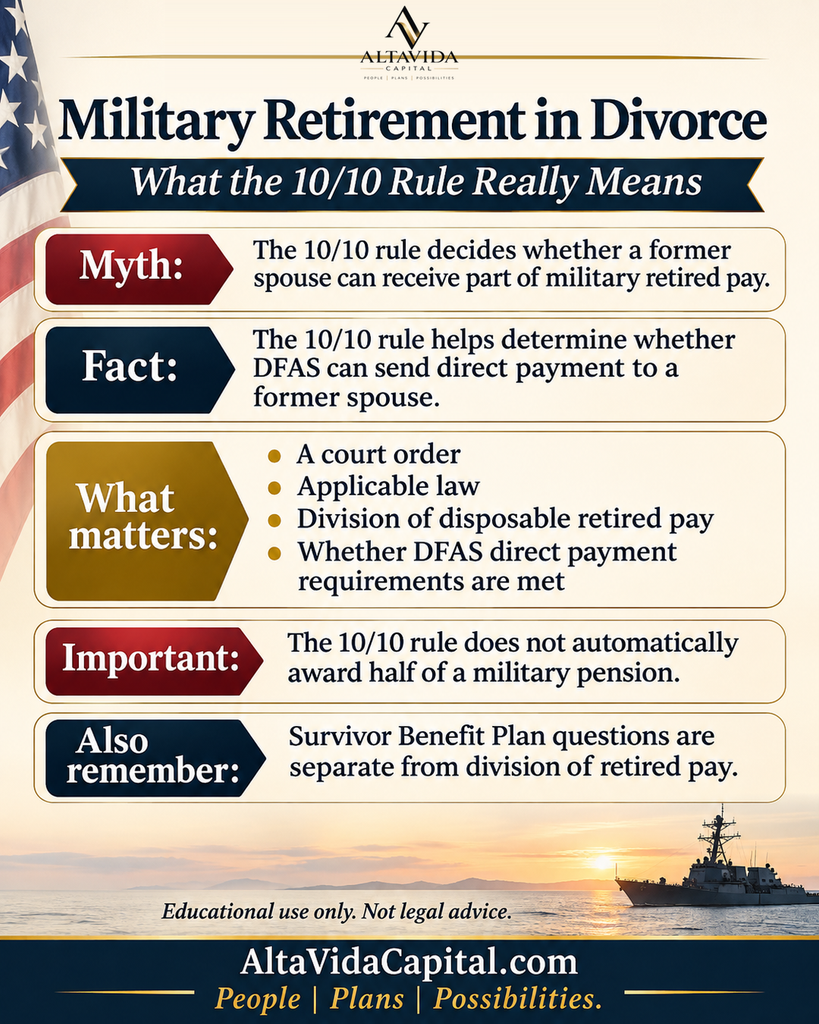
In military retirement divorce, for DFAS to pay a former spouse directly for a court-awarded division of military retired pay as property, the marriage generally must have lasted at least 10 years overlapping at least 10 years of service creditable toward retirement. This is called the 10/10 rule. Both periods must overlap; 10 years of marriage and 10 years of military service occurring separately do not satisfy it.
In military retirement divorce, not meeting the 10/10 rule does not automatically prevent a court from awarding a share of retired pay. It means DFAS generally cannot administer that property-division payment directly under this particular mechanism. If an award is enforceable, other payment or enforcement arrangements may be necessary under applicable law. Child support and alimony have different DFAS payment provisions; do not apply the property-division 10/10 test indiscriminately to them.
Court orders, DFAS payments and disposable retired pay
In military retirement divorce, three steps must not be confused: a court decides the legal award; federal law defines the portion of retired pay available for USFSPA division and DFAS enforcement; and DFAS determines whether a qualifying order and application satisfy its direct-payment requirements. A verbal agreement, a 10-year marriage or an assumption about a pension is not a substitute for the actual order.
DFAS generally requires DD Form 2293, a certified court order and other applicable documentation for former-spouse payments. The precise award language matters. DFAS may reject an application that does not satisfy the legal or documentary requirements. For certain orders that become final before retirement, special federal rules govern the calculation of disposable retired pay at the time of divorce, sometimes referred to as the frozen-benefit rule.
For military retirement divorce, it is also important to distinguish gross retired pay from disposable retired pay. Federal law specifies deductions and exclusions relevant to the USFSPA calculation, and the applicable treatment can depend on the effective date and circumstances of the order. Neither a gross pension estimate nor a percentage stated in casual conversation establishes the monthly amount a former spouse will actually receive.
Two hypothetical examples
Example 1: an award without 10 years of overlap
Suppose a couple was married for eight years that overlapped the member’s creditable military service. A state court might still divide qualifying military retired pay according to applicable law. But that eight-year overlap would not meet the 10/10 requirement for DFAS direct payment of a property award. The hypothetical says nothing about the percentage a court would award; that is a separate legal determination.
Example 2: Military Retirement Divorce: the 10/10 test is satisfied
Suppose a marriage lasted 15 years, with 12 years overlapping creditable service. The overlap could satisfy the 10/10 requirement. That fact alone does not award the former spouse a pension share. A qualifying court order, DFAS documentation and other legal requirements would still be needed. Meeting one administrative condition does not resolve the entire military retirement divorce case.
Does remarriage change a former spouse’s retired-pay award?
In military retirement divorce, remarriage is another frequent question, but the answer depends on which benefit is being discussed. A court-awarded share of military retired pay as property generally does not stop merely because the former spouse remarries, unless the governing order or applicable law provides otherwise. The same assumption should not be carried over to alimony, healthcare privileges or survivor benefits; those operate under different rules.
Likewise, the service member’s remarriage does not itself undo an existing court-ordered retired-pay property division. A person facing remarriage or a change in support arrangements should have the actual decree, amendments and benefit elections reviewed by the relevant professionals rather than relying on a blanket internet answer.
SBP former-spouse coverage is a separate issue
Division of retired pay concerns payments while the retiree is alive. The Survivor Benefit Plan (SBP) is a distinct annuity program addressing eligible survivors after the retiree’s death. A former spouse receiving a property-division payment does not automatically have former-spouse SBP protection. Coverage may depend on a valid former-spouse election, a court order or agreement, and strict filing requirements.
Where a former-spouse SBP election is required or ordered, timing can be decisive. Official military guidance describes a one-year period for requesting certain deemed elections, measured from the first order requiring coverage. Former-spouse SBP eligibility can also be affected by remarriage before age 55, with potential reinstatement if that later marriage ends. These rules are different from those governing the property share of retired pay.
For military retirement divorce education, a useful checklist therefore separates four documents: the retired-pay division provisions, the DFAS payment application, any SBP election or deemed-election requirement, and the former spouse’s own eligibility information. A single reference to ‘half the pension’ answers none of these independently.
What about TRICARE and other former-spouse benefits?
In military retirement divorce, TRICARE eligibility after divorce is not automatically determined by the 10/10 rule. Former-spouse healthcare eligibility may involve separate length-of-marriage, creditable-service and overlap requirements commonly described as 20/20/20 or 20/20/15. Eligibility also depends on additional conditions, including remarriage and other coverage circumstances. Those rules should not be mistaken for pension-division percentages or SBP eligibility.
Military OneSource offers official guidance on divorce-related benefits and resources. For a family working through a military retirement divorce, that source can help identify the correct agency and the questions to bring to legal assistance, DFAS and healthcare administrators.
Five questions to ask before assuming how the pension works
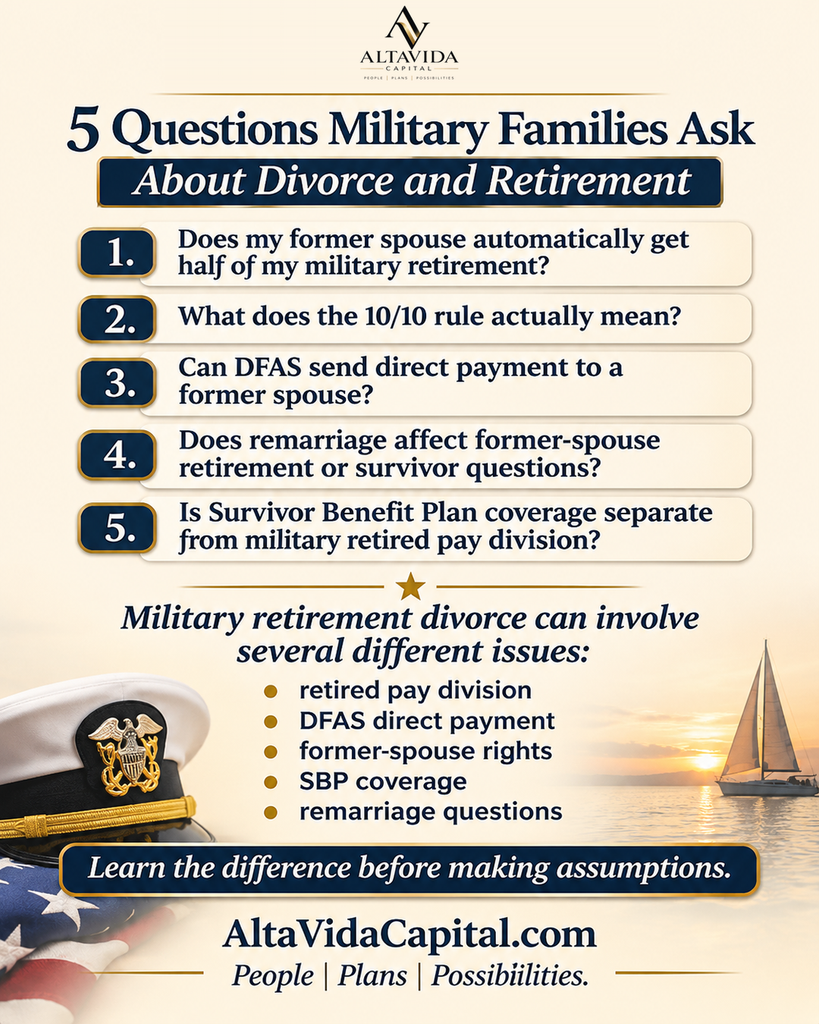
Military retirement divorce is easier to understand when each question is answered on its own terms: Is there a court-awarded property share? Does DFAS have authority to pay that share directly? What exact pay base is used? Is survivor protection in place? And what conditions affect other former-spouse benefits? These questions protect against shortcuts that collapse different laws into one misleading rule.
Frequently asked questions
What is the 10-10-10 rule in the military?
The common military retirement divorce term is the 10/10 rule, not a universal ’10-10-10′ pension rule. It refers to at least 10 years of marriage overlapping at least 10 years of creditable military service for certain DFAS direct property-division payments. Other former-spouse programs have their own separate eligibility tests.
Can my ex-wife get my military retirement if I remarry?
A court-awarded property share generally is not eliminated simply because the retired member remarries. The order and applicable law control. Questions about SBP coverage for a current or former spouse must be examined separately because different elections and beneficiary rules apply.
Can my wife take my military retirement in a divorce?
In military retirement divorce, a court may award a spouse or former spouse a share of qualifying disposable retired pay, but there is no automatic award. The governing court order and applicable law determine the property division. The 10/10 rule addresses a separate direct-payment issue.
Does an ex-wife get half of military retirement pay?
Not automatically. The proportion, if any, is determined through the legal proceeding and applicable rules. The 50% DFAS direct-payment limitation for qualifying property awards should not be misrepresented as a mandatory 50/50 division.
Can my ex-wife get my military retirement if she remarries?
A former spouse’s remarriage ordinarily does not itself terminate a court-awarded retired-pay property division, although the governing order and law matter. Former-spouse SBP, alimony and healthcare are separate issues and may have different remarriage consequences.
Before a decision: five questions worth discussing
What exactly does the court order award? Does the 10/10 overlap test apply to the requested DFAS payment? Is former-spouse SBP coverage separately addressed? Are any deadlines still open? And which official agency or qualified professional can confirm the rule for the situation? Asking these questions promotes informed decisions without assuming that one answer resolves every benefit.
Conclusion: distinguish entitlement, direct payment and survivor protection
The central lesson of military retirement divorce is that court-awarded retired pay, DFAS direct payment, SBP coverage and former-spouse healthcare are separate subjects. The 10/10 rule is important, but it does not award half a pension and cannot substitute for reading the actual decree. The safest educational approach is to verify each claim against current official guidance and refer legal determinations to qualified counsel.
AltaVida Capital provides military retirement and family financial readiness education. Explore related military retirement and survivor protection resources at AltaVidaCapital.com. This article does not provide individualized legal, tax or investment advice and does not replace advice from a qualified attorney.
Official Sources: Military Retirement Divorce — verified reference links
- DFAS — USFSPA Frequently Asked Questions — https://www.dfas.mil/Garnishment/usfspa/faqs/
- DFAS — Legal requirements for former-spouse direct payment — https://www.dfas.mil/garnishment/usfspa/legal/
- DFAS — Maximum payment rules — https://www.dfas.mil/Garnishment/usfspa/maximumpay/
- DFAS — Former-spouse SBP and remarriage — https://corpweb1.dfas.mil/askDFAS/faqView.action?faq.faqId=30189&pgModId=12
- DoD Military Compensation — SBP spouse coverage — https://militarypay.defense.gov/Benefits/Survivor-Benefit-Plan/Costs-and-Benefits/Spouse-Coverage/
- Military OneSource — USFSPA overview — https://www.militaryonesource.mil/benefits/uniformed-services-former-spouses-protection-act/
- Military OneSource — Divorced military spouse rights — https://www.militaryonesource.mil/relationships/separation-divorce/divorced-military-spouse-rights-benefits/
- U.S. Code — 10 U.S.C. § 1408 — https://uscode.house.gov/us/usc/119-136/t10/s1408/
- DFAS — 2017 NDAA retired pay division change — https://www.dfas.mil/garnishment/Fliers/Former-Spouse-Payments/
- Army Benefits — former-spouse SBP deemed election — https://myarmybenefits.us.army.mil/Benefit-Library/Federal-Benefits/Survivor-Benefit-Plan-%28SBP%29?serv=126