
Survivor Benefit Plan Explained
Last reviewed: July 29, 2026. Educational content prepared by Alta Vida Capital. Alta Vida Capital is not affiliated with, endorsed by, or acting on behalf of the Department of Defense, DFAS, the Department of Veterans Affairs, TRICARE, or any government agency.
What is the Survivor Benefit Plan?
The Survivor Benefit Plan, commonly called SBP, is a Department of Defense annuity program that allows a military retiree to continue part of retired pay to an eligible survivor after the retiree dies.
Military retired pay stops when the retiree dies. It does not automatically transfer to a spouse or family member. SBP can replace part of that lost monthly income by paying an eligible beneficiary an inflation-adjusted annuity based on the coverage elected by the retiree.
SBP is generally elected during retirement processing. Premiums are normally withheld from gross retired pay, and the election can be difficult or impossible to change later except under specific statutory rules or authorized election windows.
Because SBP provides continuing monthly income rather than a one-time lump sum, families should review it alongside:
- life insurance;
- Social Security survivor benefits;
- VA survivor benefits;
- TRICARE eligibility;
- TSP and other retirement accounts;
- savings and investments;
- the spouse’s pension, earnings, or other income;
- estate and trust planning.

How does the Survivor Benefit Plan work?
SBP generally operates through four components.
- The retiree elects’ coverage
During retirement processing, the service member identifies:
- who will be covered;
- the amount of retired pay used as the coverage base;
- whether coverage will be full or reduced;
- whether spouse, child, former-spouse, or another permitted coverage category applies.
The base amount may generally range from a minimum established under program rules up to full retired pay. The survivor annuity for ordinary spouse coverage is generally 55% of the elected base amount. The base amount, premium, and annuity generally increase when applicable cost-of-living adjustments are applied.
- Premiums are withheld from retired pay
The retiree pays monthly premiums from gross retired pay.
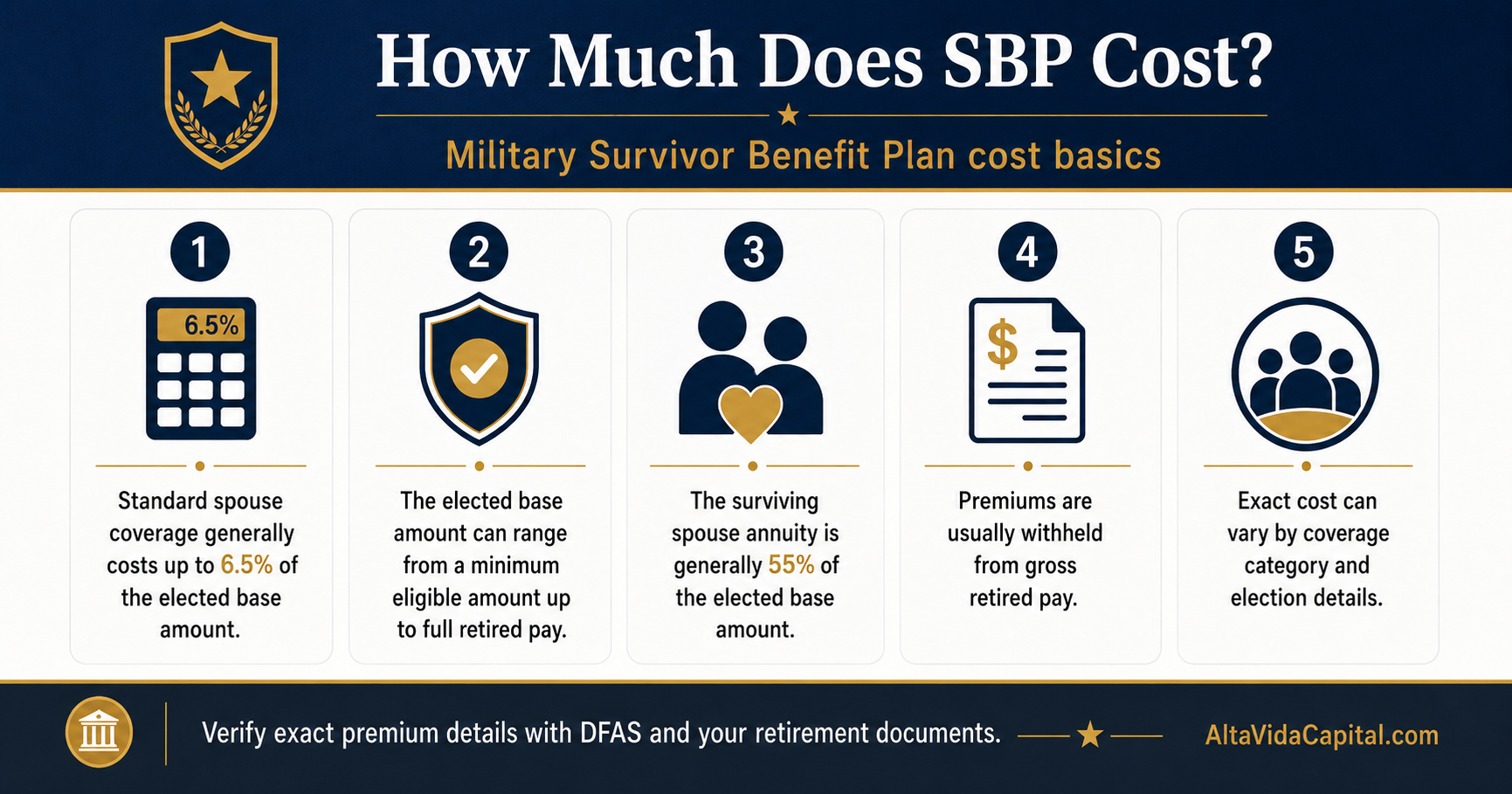
For standard spouse coverage, the cost is generally no more than 6.5% of the elected coverage base, although an alternative calculation can apply to some retirees. Coverage category, retirement system, beneficiary type, and elected base amount affect the precise premium.
Premiums paid from gross retired pay generally reduce taxable retired-pay income. Families should verify the tax treatment with DFAS and a qualified tax professional.
- Retired pay stops at death
When the retiree dies, military retired pay ends. Payments deposited after death may be recovered by DFAS.
The surviving beneficiary does not simply continue receiving the retiree’s existing retirement deposit.
- The eligible survivor applies for the annuity
An SBP annuity is not automatically deposited merely because the beneficiary was covered. The survivor must notify DFAS, submit the required forms and documents, and establish eligibility.
The resulting annuity is generally paid monthly and can continue for the beneficiary’s lifetime, subject to applicable eligibility rules.
Who can be covered by SBP?
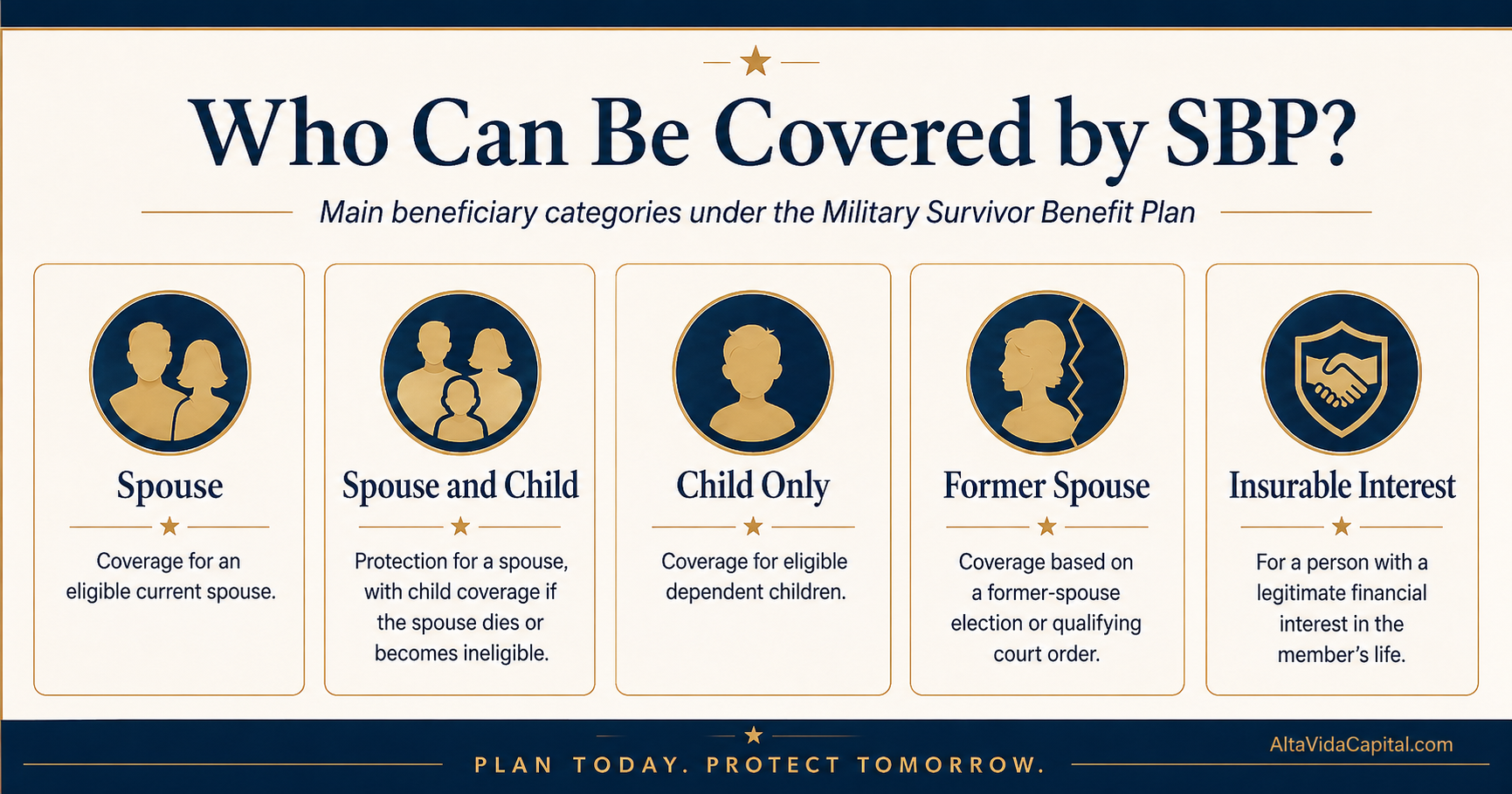
Coverage categories may include:
- spouse only;
- spouse and child;
- child only;
- former spouse;
- former spouse and child;
- a person with an insurable interest, when permitted.
The election category matters. A retiree cannot assume that one type of coverage can be freely converted to another later.
Spouse coverage
Spouse coverage is the most common election. Full coverage generally uses full retired pay as the base amount.
Spouse and child coverage
The spouse is normally the primary beneficiary. Eligible children generally receive the annuity only if the spouse dies or otherwise becomes ineligible.
Child-only coverage
A married member who elects child-only coverage rather than spouse coverage generally needs the spouse’s notarized concurrence.
Former-spouse coverage
Former-spouse coverage is a distinct election and requires separate action. It is not completed automatically merely because a divorce decree discusses SBP.
Insurable-interest coverage
A member without an eligible spouse or child may be permitted to cover another person who has a legitimate financial interest in the member’s life. Costs and benefit calculations differ substantially from spouse coverage.
When is the SBP election made?
The principal election is generally made during retirement processing.
This timing is important because:
- the election affects monthly retired pay;
- spouse concurrence may be required;
- coverage generally becomes effective at retirement;
- later changes are limited;
- declining coverage can permanently remove the opportunity to provide spouse SBP protection.
Timing | What generally occurs | Why it matters |
Before retirement | Counseling, estimates, beneficiary review, election preparation | Main decision period |
During retirement processing | Election and required signatures are completed | Determines initial coverage |
After retirement | Changes are restricted | Families cannot assume coverage can be added later |
Marriage, divorce, or dependent changes | Limited statutory election periods may apply | Deadlines must be verified |
Congressional open season | May permit special changes | Rare and not a dependable planning strategy |
Reserve Component members may make a Reserve Component Survivor Benefit Plan election when notified of eligibility for non-regular retirement, often years before retired pay begins. Their rules and timing require separate review.
When is spouse concurrence required?
If the member is married and chooses anything less than full spouse coverage, the spouse’s notarized concurrence is generally required.
DFAS identifies three common situations requiring spouse concurrence:
- child-only coverage;
- less than full spouse coverage;
- declining SBP coverage entirely.
The spouse’s signature must generally be notarized, and the election must be completed correctly and on time. An invalid election may result in automatic full spouse coverage and corresponding premiums.
Practical review
Before signing:
- confirm the beneficiary category;
- confirm the elected base amount;
- obtain the premium estimate;
- estimate the survivor annuity;
- understand the tax treatment;
- compare existing life insurance and assets;
- review whether the survivor needs lifetime income;
retain copies of the election and concurrence documents
How much does SBP cost?
The cost depends on:
- coverage category;
- elected base amount;
- retirement system;
- beneficiary type;
- ages of the retiree and beneficiary in certain categories;
- whether full or reduced coverage is selected.
For ordinary spouse coverage, the maximum standard premium is generally 6.5% of the elected base amount. The surviving spouse annuity is generally 55% of that base amount.
Illustrative structure
Item | How it works |
Retired pay | Monthly military retirement amount |
Elected base | Amount of retired pay protected by SBP |
Premium | Amount withheld from retired pay |
Survivor annuity | Monthly amount payable to the eligible beneficiary |
COLA treatment | Base, premium, and annuity generally adjust under program rules |
Paid-up status | Premiums may stop after statutory age and payment thresholds are satisfied |
Under the standard paid-up provision, a retiree generally becomes paid up after reaching age 70 and making 360 months of premium payments. Both requirements must be satisfied.
Do not rely on generic examples for an actual election. Obtain the official individualized estimate before retirement.
Is the Survivor Benefit Plan worth it?
There is no universal answer.
SBP may be highly valuable for one household and less central for another. The correct analysis depends on the survivor’s income needs, longevity risk, other assets, insurance availability, taxes, health, and family circumstances.
Use this six-question framework.
- How dependent is the household on retired pay?
Ask:
If retired pay stopped tomorrow, how much essential household spending would no longer be funded?
Consider:
- housing;
- food;
- utilities;
- healthcare;
- transportation;
- debt;
- dependent support;
- taxes;
- long-term care.
- How long would the income need continue?
The survivor may need income:
- temporarily;
- until Social Security begins;
- until another pension begins;
- until dependents become independent;
- for life.
A lifetime need is different from a short-term liquidity need.
- Does the survivor need inflation-adjusted income?
SBP generally provides continuing monthly income with applicable cost-of-living adjustments.
A fixed life-insurance death benefit does not automatically increase after it is paid. The survivor must manage and invest the proceeds.
- What other resources already exist?
Review:
- life insurance;
- savings;
- investments;
- pensions;
- Social Security;
- DIC;
- TSP;
- spouse earnings;
- rental income;
- trust assets;
- other retirement accounts.
Do not count the same dollar twice.
- Is comparable private coverage available?
Commercial life insurance may provide greater flexibility and a lump-sum death benefit, but it may require medical underwriting.
Health, age, coverage duration, policy type, and premium guarantees affect whether private insurance is a realistic substitute or complement.
- What happens if the survivor lives much longer than expected?
SBP transfers much of the longevity risk to the program because an eligible spouse annuity can continue for life.
With life-insurance proceeds or investments, the survivor carries the risk of:
- spending too quickly;
- poor investment performance;
- inflation;
- market losses;
- living longer than expected.
Decision principle
SBP should not be evaluated as though it were an investment account that must produce a measurable rate of return.
It is primarily a survivor-income and longevity-risk protection decision.
Can SBP and life insurance be used together?
Yes.
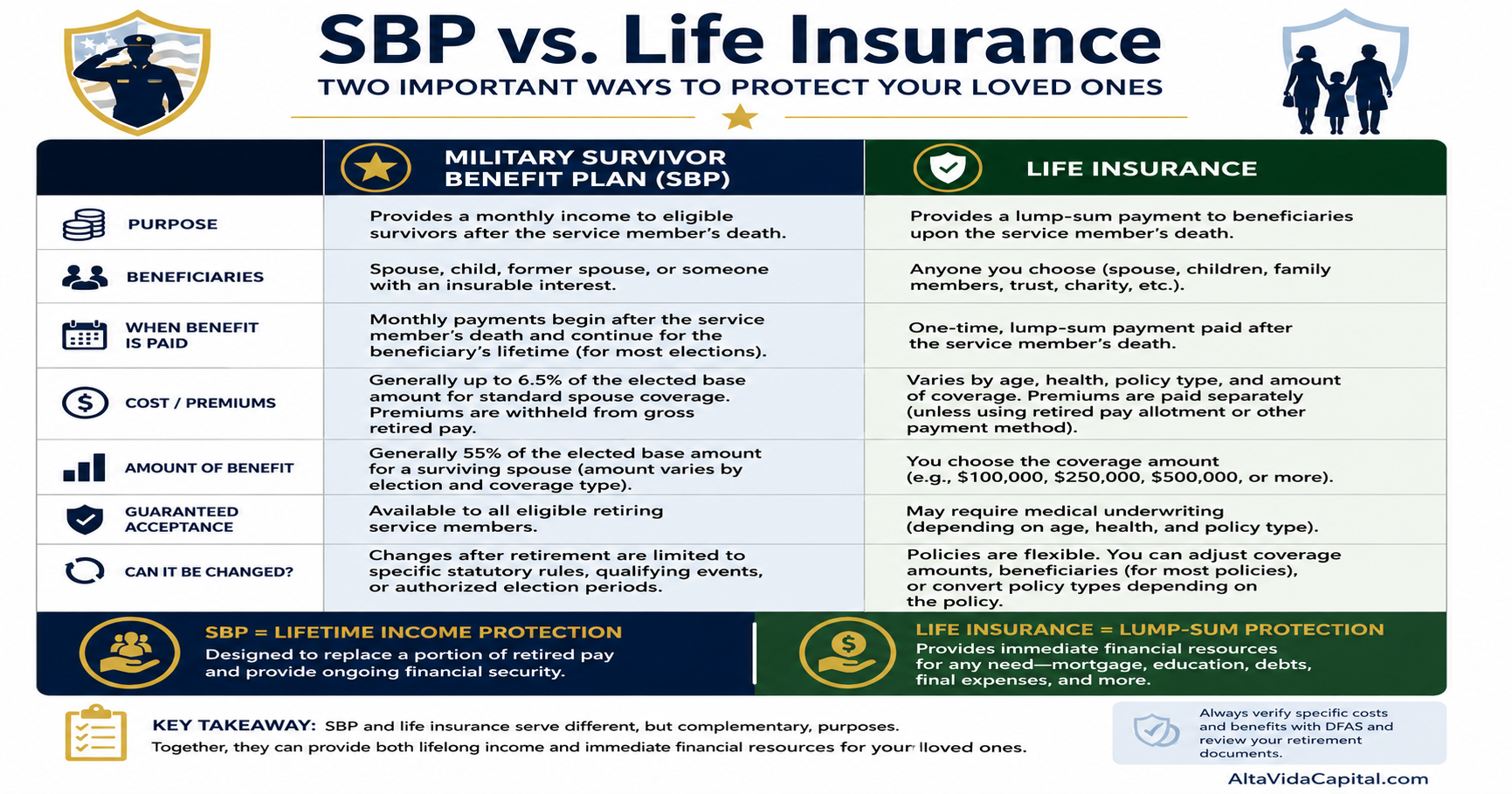
They can serve complementary purposes.
SBP may provide:
- recurring monthly income;
- longevity protection;
- inflation adjustment;
- protection without medical underwriting.
Life insurance may provide:
- immediate liquidity;
- debt payoff;
- funeral and final expenses;
- mortgage protection;
- funds for children;
- an inheritance;
- trust funding;
- flexibility in how proceeds are used.
A family could use SBP for essential monthly income and life insurance for immediate cash needs or legacy planning.
Neither should be selected solely because another family made the same decision.